

You may want physical intimacy without a committed romantic relationship. You may also feel unsure whether a casual arrangement would suit you. Among adults who can freely consent, the useful starting point is to talk about what each person wants and what they are willing to agree to.
“Casual” does not mean having no responsibilities toward each other. Consent, honesty, privacy and consideration still matter. Clear conversations can make expectations easier to understand, but they cannot guarantee that nobody will develop feelings or feel disappointed.
On this page
- Consider what would suit you now
- Keep consent and limits ongoing
- Get to know a new match carefully
- Make an invitation without pressure
- Discuss expectations before assuming agreement
- Make sexual health part of the conversation
- Check in when feelings or needs change
- Choose what fits without proving anything
1. Consider what would suit you now
Ask yourself what you hope to enjoy and what might feel difficult. You might want companionship, sexual connection or the freedom to date without planning a shared future. None of those wishes tells you in advance how a particular encounter will feel.
Consider your time, energy, privacy and emotional needs. Would you be comfortable if the person dated someone else? Are you hoping the arrangement will eventually persuade them to commit? You do not need perfect confidence, but it helps to be honest with yourself about a mismatch.
Wanting affection or reassurance does not make you unfit to date. You can acknowledge those needs and decide whether this arrangement can meet them. You are also allowed to pause or decide that casual intimacy is not what you want.
2. Keep consent and limits ongoing
Talk about what you want, what you do not want and what you need to ask about first. Consent applies to the particular activity happening now; a previous encounter or agreement to meet is not permission for everything that might follow.
The HSE’s guidance on sexual consent explains that agreement must be freely given and can be withdrawn. If someone becomes unsure, pulls away or stops responding, stop and check rather than treating silence as agreement. Do not continue with someone who is asleep or too intoxicated to understand and choose.
You can set or change a limit later, including in the moment. “I don’t want to continue,” “Please stop,” or “I have changed my mind about staying overnight” does not require a persuasive explanation. Respect the other person’s limits without bargaining or making them feel guilty.
Include digital privacy too. Ask before taking an intimate photo, and get separate permission before sharing anything. Agreeing to one kind of contact does not grant access to someone’s phone, accounts or personal information.
3. Get to know a new match carefully
An app profile may help you find someone looking for a similar arrangement, but a profile and friendly messages cannot verify everything about a person. Be honest about what you are seeking without sharing information you would prefer to keep private.
You can choose an initial meeting in a public place, arrange your own way home and let a trusted person know your plans. Keep the first meeting separate from a promise of intimacy. You can enjoy the conversation and decide not to go further.
If someone presses for your home address, money or a decision before you are comfortable, you can decline and end contact. Being interested in casual sex does not mean you must accept another person’s proposed pace or setting.
4. Make an invitation without pressure
A greeting is enough to begin: introduce yourself, ask a question and see whether the other person wants to continue talking. A match, a smile or flirtation does not establish consent to sexual contact.
When the conversation is welcome, be clear about your interest. For example, “I’m not looking for a committed relationship at the moment. Is getting to know someone on that basis something you want?” Give them room to disagree without trying to sell them on the idea.
If the answer is no, accept it. If the answer is unclear, slow down or leave it there. Repeated requests after reluctance can create pressure; another person’s uncertainty is not a challenge to overcome.
5. Discuss expectations before assuming agreement
People use “hookup,” “casual dating” and “friends with benefits” differently. Explain what you mean in practical terms instead of relying on the label to carry the conversation.
- Contact: do you want occasional messages, dates or only contact to arrange a meeting?
- Other partners: is the arrangement exclusive, and what do you need to discuss if that changes?
- Privacy: what are you comfortable telling friends, and what should stay private?
- Changes: how will you tell each other if you want to pause, stop or discuss something different?
Neither person has to agree to a format that does not suit them. Someone may want affection and regular time together while you want occasional contact. Naming the difference is more useful than promising that a casual label will prevent attachment.
6. Make sexual health part of the conversation
Before sexual contact, discuss STI testing, condoms or other relevant protection, and contraception if pregnancy is possible. Talk about any conditions of your agreement, including protection you expect to use. Do not leave an important condition to a guess.
If you need advice about suitable options or testing, contact a qualified sexual-health service. The NHS guide to visiting a sexual health clinic explains the tests, treatment and contraception advice available through clinics in England. Elsewhere, look for the equivalent service where you live.
You can postpone intimacy while you get information or discuss a concern. Neither embarrassment nor someone else’s impatience requires you to proceed before you are comfortable.
7. Check in when feelings or needs change
Feelings can develop, fade or become more complicated. You do not have to hide them to remain “good” at a casual arrangement. Notice when you want something different and talk about it without assuming the other person must change their wishes too.
You might say, “I’ve started wanting a relationship, and continuing casually is not working for me.” The other person may want to explore that possibility or may still want the original arrangement. You can then choose whether continuing, taking space or ending contact fits your needs.
Keep behaviour consistent with current agreements. If you no longer want to continue, say so clearly when it is safe. Practical messages can be brief and respectful; you do not need a long argument or the other person’s permission to end the arrangement.
8. Choose what fits without proving anything
You do not have to pursue casual intimacy to show that you are modern, confident or over a previous relationship. You do not have to avoid it to satisfy someone else’s expectations either. Consider your values, your comfort and whether the actual arrangement leaves both adults with genuine choice.
Privacy is yours to choose, but it need not mean isolation. You can seek support from someone trustworthy without sharing another person’s intimate details. If something has felt pressured, frightening or non-consensual, consider a local sexual-assault support or healthcare service.
A workable arrangement can include pleasure, warmth and care while still having a limited role in your life. Keep reviewing whether it suits you now, and let yourself change course without treating that change as a failure.
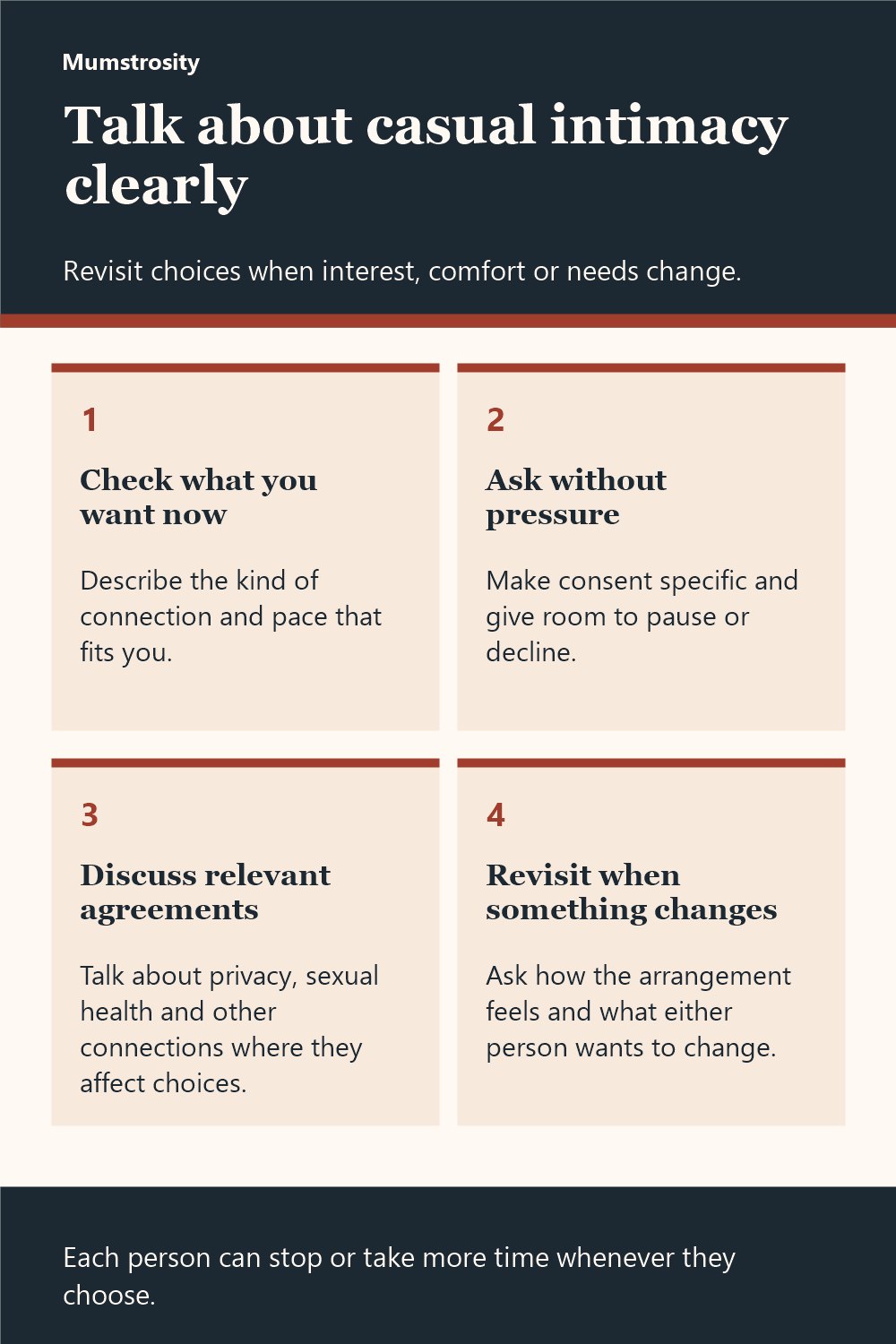
Read the infographic in text
Talk about casual intimacy clearly Revisit choices when interest, comfort or needs change.
- Check what you want now Describe the kind of connection and pace that fits you.
- Ask without pressure Make consent specific and give room to pause or decline.
- Discuss relevant agreements Talk about privacy, sexual health and other connections where they affect choices.
- Revisit when something changes Ask how the arrangement feels and what either person wants to change.
Each person can stop or take more time whenever they choose.