

When a request comes with guilt, intimidation or a threat, it can become difficult to work out what you actually want. You may find yourself agreeing just to prevent the next argument. You deserve room to make choices without being frightened into them.
“Emotional blackmail” is a way people describe pressure that uses a close relationship to obtain compliance. The label cannot tell you someone’s diagnosis or explain their private motives. What matters is the behavior, whether you can safely disagree and what support you need.
On this page
1. Recognize pressure attached to a demand
Disappointment and disagreement happen in relationships. A concerning pattern is using consequences to make refusal feel dangerous or impossible. The demand may involve your friendships, money, privacy, work or decision to stay in the relationship.
- A partner says you must cancel plans with a friend to prove your love.
- Someone threatens to share private information unless you give them access to an account.
- A person makes you responsible for preventing their violence or self-harm by doing what they want.
- Support is repeatedly made conditional on surrendering a choice you have already said matters to you.
These are examples, not a checklist you must complete before seeking help. One serious threat deserves attention. You do not have to establish whether someone intended to manipulate you before taking your fear or discomfort seriously.
2. Look at what happens when you disagree
A useful question is: “Can I say no without being punished, threatened or worn down until I agree?” Notice whether the person hears your answer, allows a pause and takes responsibility for their own behavior.
Consider a recent exchange. What was requested? What did you say? What happened next? Perhaps the conversation returned to the same demand after every refusal, or an apology was followed by another threat. Concrete details are more useful than trying to decide whether the person is entirely good or bad.
You might notice yourself rehearsing every word, apologizing for ordinary choices or avoiding people to prevent a reaction. Those experiences do not prove a diagnosis, but they are worth discussing with someone who can listen without pressuring you.
3. Pause and choose a response safely
If it is safe, give yourself time before agreeing to a pressured request. You might say, “I need time to think about that,” or “I can talk about the problem, but I am not sharing my password.” You do not need a long argument that convinces the other person your boundary is reasonable.
Choose a boundary you can act on, such as ending an insulting call or discussing practical matters through an agreed channel. A boundary is not a reliable way to prevent retaliation. If you are afraid of what will happen, work with an abuse advocate on safer options before confronting the person.
If keeping notes would help, record what happened only where it is safe to do so. A shared phone, cloud account or paper notebook may be accessible to the person involved. You can seek support without producing a perfect log or collecting evidence at personal risk.
4. Take threats seriously
Threats to harm you, another person or themselves need more support than a relationship debate. If danger is immediate, contact local emergency services when safe to do so. Avoid going alone to manage a crisis that could put you at risk.
If a partner threatens suicide to stop you leaving or refusing a demand, you can care about their safety without promising compliance. The US National Domestic Violence Hotline’s guidance on a partner’s threats of suicide explains that these threats should be taken seriously and that support is available. In the US, call or text 988 for suicide-crisis support; elsewhere, use an appropriate local crisis service.
You are not required to remain in a relationship, provide physical affection or give money to become someone’s sole crisis response. An advocate or crisis professional can help you consider the threat and your safety together.
5. Build support around your choices
Consider someone outside the situation who will respect your decisions: a trusted friend, an individual counselor or a domestic-abuse advocate. Tell them a specific example and what would help now. You might need a private conversation, help finding services or someone to check in after an appointment.
If children, housing, money or immigration concerns affect your options, say so when asking for support. A plan needs to fit your real circumstances. You do not have to make every decision during the first conversation, and staying for now does not remove your right to help.
The other person is responsible for changing their harmful behavior. Arranging treatment for them is not a condition you must meet before protecting yourself. If they promise change, consider their behavior over time, including whether they respect your independent choices and access to support.
Read the infographic in text
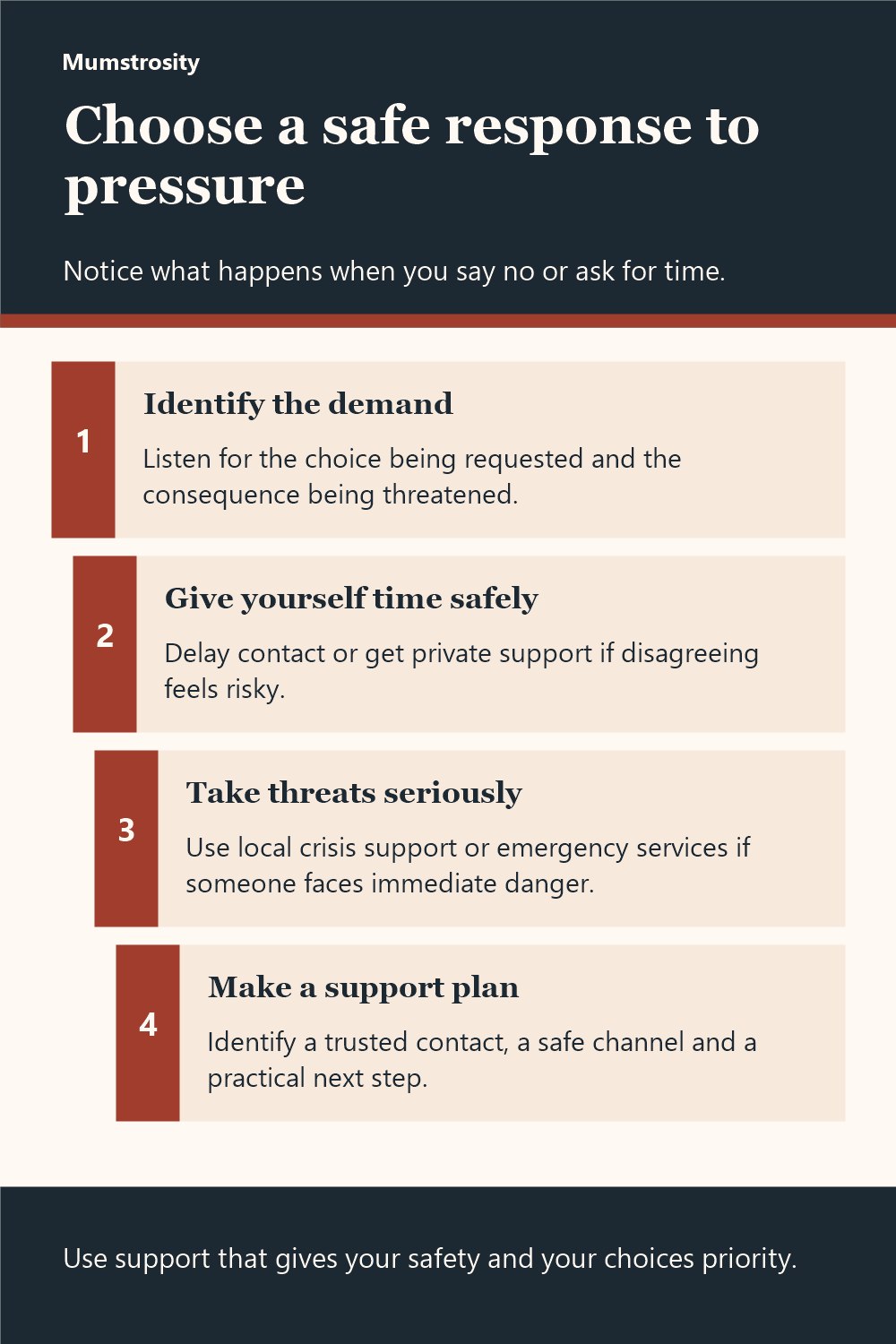
Choose a safe response to pressure Notice what happens when you say no or ask for time.
- Identify the demand Listen for the choice being requested and the consequence being threatened.
- Give yourself time safely Delay contact or get private support if disagreeing feels risky.
- Take threats seriously Use local crisis support or emergency services if someone faces immediate danger.
- Make a support plan Identify a trusted contact, a safe channel and a practical next step.
Use support that gives your safety and your choices priority.