

If you are wondering whether he likes you, a list of small signals can be tempting. A message, a glance or a friendly conversation may feel promising, but none can tell you exactly what another person wants. Look for a pattern of mutual interest and, when the setting allows it, a clear conversation.
You can feel nervous while getting to know someone who treats you well. You can also feel attracted to someone whose behaviour does not meet your needs. The aim is to understand what is happening and choose your next step, without making your worth depend on his answer.
On this page
Notice interest without treating it as proof
Someone may show interest by starting conversations, asking about your life, suggesting time together or telling you they would like to date. Those observations can give you something to discuss. They do not establish exclusivity, long-term compatibility or a commitment that has never been agreed.
Friendliness, eye contact and physical affection have different meanings for different people. Shyness, disability, communication preferences and cultural habits can also affect how interest is expressed. Avoid making one gesture, response time or style of conversation the deciding test.
It can help to separate the observation from the interpretation: “He suggested meeting on Saturday” is something you know. “That means he wants a serious relationship” still needs a conversation.
Look at effort in context
Ask whether both people have room to initiate and whether plans are reasonably clear. If a plan falls through, does he explain and offer another possibility? Does he remember what you have said and take your preferences seriously? Notice the pattern rather than counting every message.
Work, parenting, illness and other responsibilities can limit availability. Interest does not require someone to be constantly reachable or put you ahead of every other commitment. At the same time, you can decide that repeated uncertainty or very little contact does not suit the relationship you want.
You might say, “I enjoy seeing you, but last-minute plans are difficult for me. Could we arrange something earlier?” The response tells you something useful about whether your needs can be discussed, even if it cannot reveal every feeling.
Ask a clear, low-pressure question
If it is appropriate to ask and he can decline freely, try a specific invitation: “Would you like to have coffee as a date?” If you are already dating, the question might be, “What are you looking for at the moment?” Choose a private enough setting without putting someone on the spot.
You do not need to persuade him to give the answer you hope for. A no, a statement that he wants friendship or a different relationship goal deserves to be taken seriously. If an answer is unclear, you can ask once for clarification and decide how much uncertainty you are willing to continue with.
You can also choose not to pursue the question. Workplace power differences, an existing commitment or your own discomfort may make stepping back the more suitable choice.
Keep your comfort and independence in view
Someone liking you does not make every behaviour acceptable. Pressure for sex, demands to inspect your phone, insults, possessiveness or attempts to isolate you deserve attention regardless of attraction. Ending use of dating apps should be a mutual agreement about exclusivity, not an order or an assumed obligation.
Your feelings are worth noticing without treating anxiety as proof that the connection is wrong or intuition as proof that it is right. Ask what actually happened, what you need and whether you feel able to say no. If you are afraid of his response, seek private support rather than relying on a confrontation to resolve it.
The NHS guidance on healthy relationships includes maintaining personal interests and boundaries. Keep time for friends, family, parenting and ordinary routines while you get to know someone.
Decide what to do with the answer
If interest is mutual, choose a next step you both want and continue learning about each other. If it is not mutual, allow disappointment without turning the answer into a judgment about your attractiveness or future. Distance from messages or social updates may help you redirect your attention.
If the situation remains vague, you are allowed to set a limit: “I am looking for something clearer, so I am going to step back.” You do not need to prove that he is a bad person or decode his private motives. What you know about the contact and what you want from it can be enough to make a choice.
Read the infographic in text
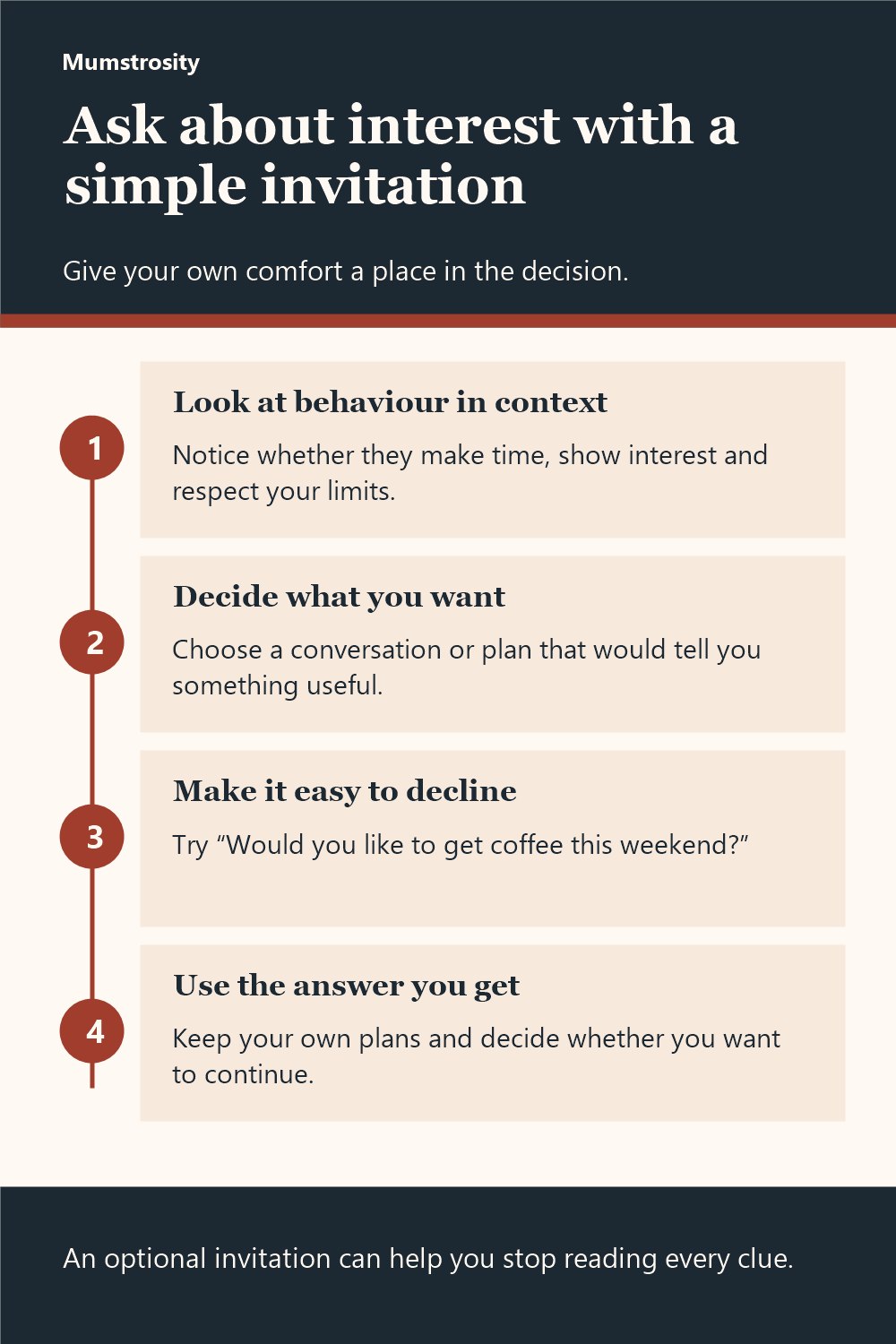
Ask about interest with a simple invitation Give your own comfort a place in the decision.
- Look at behaviour in context Notice whether they make time, show interest and respect your limits.
- Decide what you want Choose a conversation or plan that would tell you something useful.
- Make it easy to decline Try “Would you like to get coffee this weekend?”
- Use the answer you get Keep your own plans and decide whether you want to continue.
An optional invitation can help you stop reading every clue.