

A long-distance relationship can leave room for your own routines and encourage deliberate time together. It can also involve loneliness, travel costs and missing ordinary moments. Neither experience proves how much you love someone. The useful question is whether this arrangement works for both of you in the lives you have now.
In this article
Make room for a life in each place
Keep friendships, interests and responsibilities where you live. You do not need to keep every evening free in case your partner calls. Talk about the time you realistically have, including work, parenting, study, health needs and rest.
Independence is not something you have to earn through distance. People living together also need room for their own choices. Being apart may create opportunities for personal projects, but it does not automatically produce confidence, growth or a stronger relationship.
Agree how to stay connected without staying on call
Discuss what kinds of contact feel enjoyable and manageable. A short voice message may suit a busy day; a longer call may need a planned time. Account for time zones, accessibility and the fact that energy and privacy can vary from day to day.
Try a specific arrangement, such as two planned calls a week with optional messages between them, then review it together. Agree how to cancel or reschedule. A missed call deserves context rather than an automatic conclusion that someone no longer cares.
Connection can include ordinary details: a photo of something you cooked, a shared playlist, a game or talking while each of you does a household task. These are options, not a daily performance of devotion. Either person can want a quiet evening without having to prove what they did instead.
Plan visits around real limits
Discuss travel time, costs and who can make the journey before booking. An equal number of trips may not be fair if your incomes, caring commitments or access needs differ. Look for an arrangement both people can afford without pressure, and be honest about what is currently possible.
Leave space in a visit for rest and ordinary life. Every weekend together does not need to be an expensive holiday or a test of the relationship. Ask about physical affection and privacy rather than assuming that time apart creates an obligation to be intimate.
Travel disruptions and changed responsibilities may require a new plan. Notice whether disappointments can be discussed respectfully. Repeatedly making one person carry the costs or guilt-tripping them for unavailable time deserves attention, even when the distance is difficult.
Talk about what the future might realistically involve
Ask whether you both want to live nearer each other eventually, or whether a longer period apart could suit you. You do not need a fixed moving date immediately. It helps to understand the constraints, the possibilities and what each person would be giving up.
Include concrete questions: whose work could move, what housing would cost, how family responsibilities would change and whether a trial visit is feasible. Avoid treating relocation as proof of commitment or assuming that one person’s career should automatically come second.
A review date can be more honest than a promise you cannot keep. For example, agree to discuss the arrangement again when a course ends or a work contract changes. If your plans no longer fit, acknowledging that does not make either person’s earlier care false.
Review respect as well as the amount of contact
Distance does not explain away threats, humiliation or control. Love is respect describes warning signs in long-distance relationships, including pressure to surrender digital privacy or sacrifice other parts of life. More access to a partner is not the same as more trust.
You can decline location sharing, password access, constant video calls or sexual images. Agreeing once does not prevent you from changing your mind. If you are afraid of a partner’s response, consider private help from a relationship-abuse support service rather than relying on another joint conversation to resolve the problem.
For an ordinary check-in, ask: Do we both have room to say no? Are plans and costs workable? Is time together enjoyable enough to continue? What needs to change? You might adjust the routine, plan a visit, seek support or decide that the relationship no longer suits you. Effort matters, but it cannot guarantee that staying together is the right outcome.
Read the infographic in text
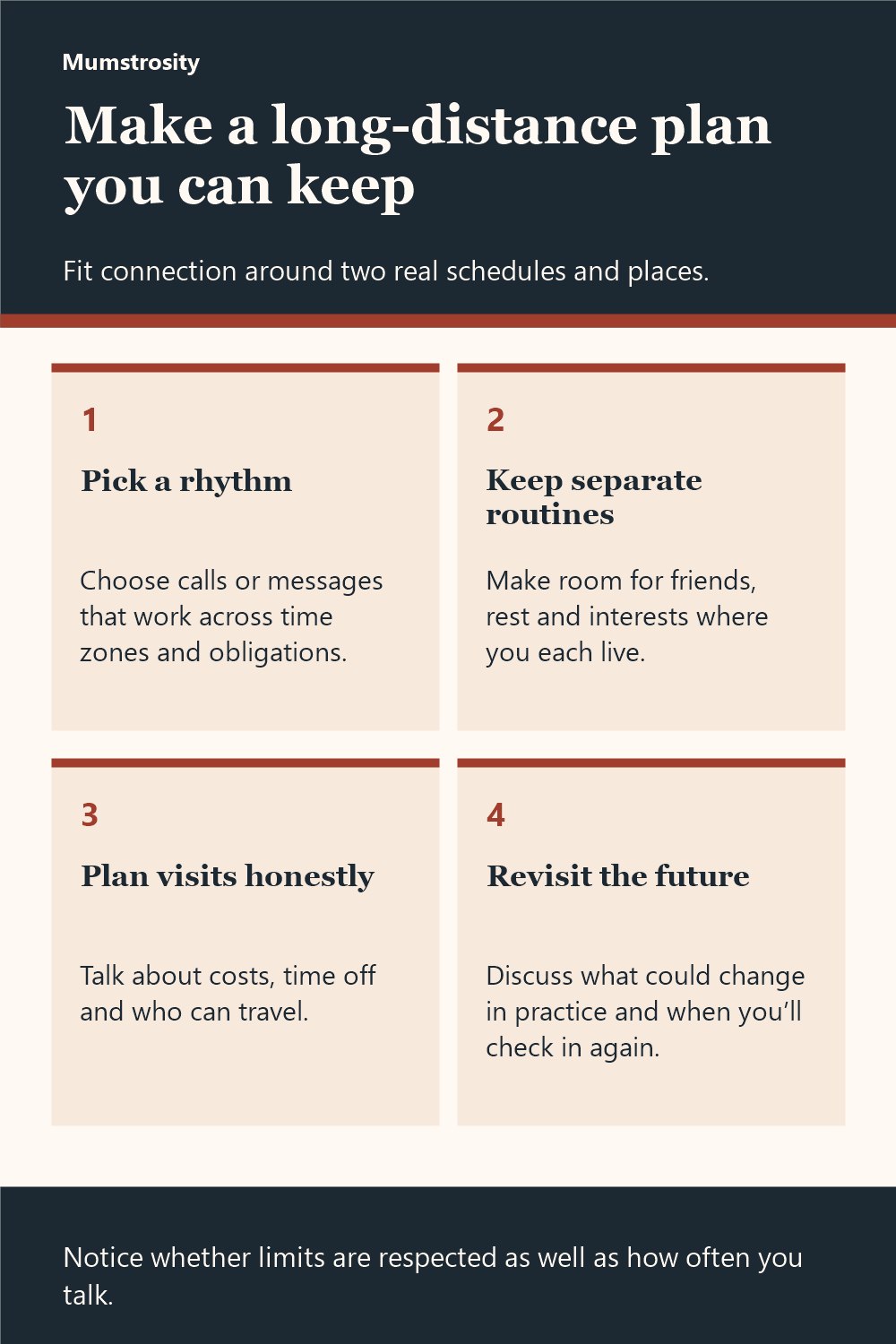
Make a long-distance plan you can keep Fit connection around two real schedules and places.
- Pick a rhythm Choose calls or messages that work across time zones and obligations.
- Keep separate routines Make room for friends, rest and interests where you each live.
- Plan visits honestly Talk about costs, time off and who can travel.
- Revisit the future Discuss what could change in practice and when you’ll check in again.
Notice whether limits are respected as well as how often you talk.