

Midlife relationship changes often become visible through ordinary details: less energy after work, more care for a parent, a wish for solitude or a new interest that needs time. Naming that detail gives a conversation somewhere concrete to begin.
You do not need to decide immediately what the change means for your whole relationship. Explain what is different, listen to your partner's experience and consider an arrangement that respects each person's health, responsibilities and choices.
Turn a changing need into a clear request
Read the guide as text
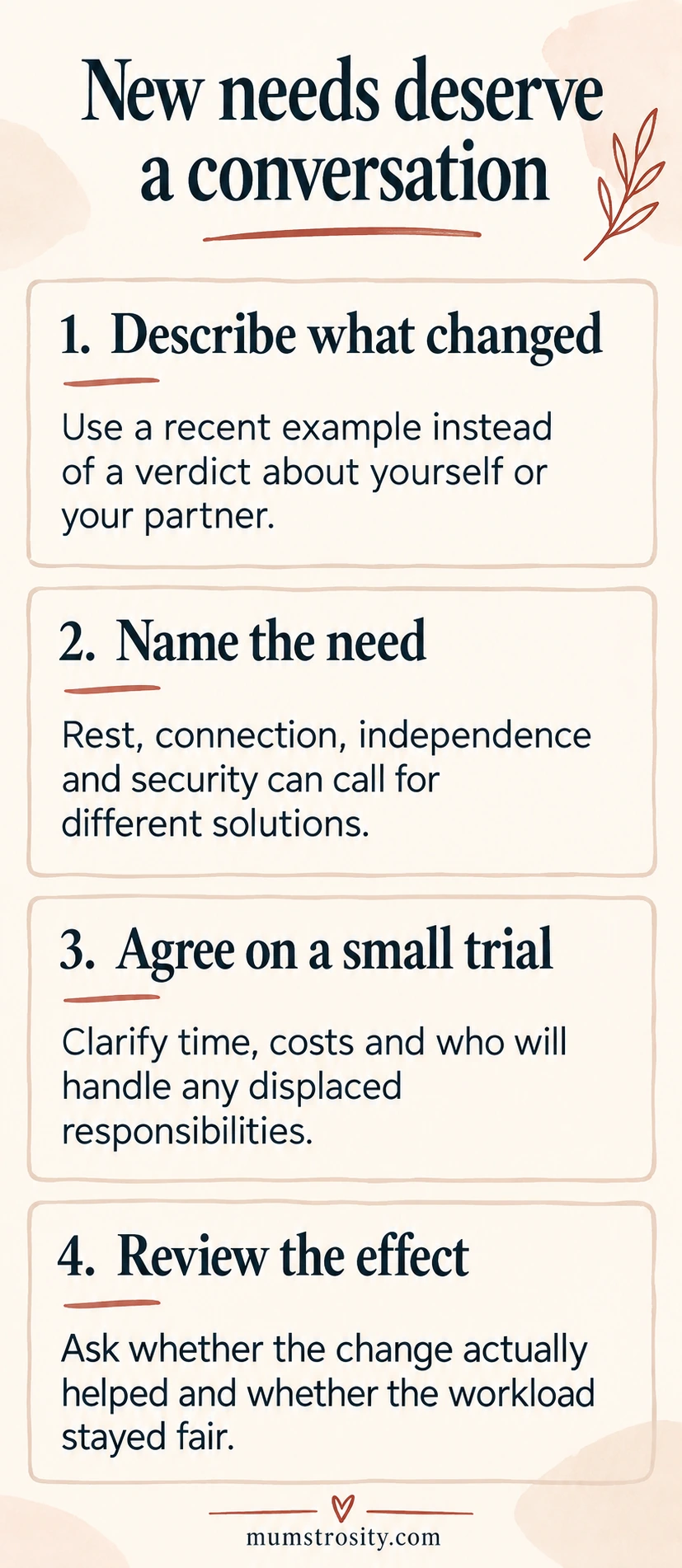
- Describe what changed. Use a recent example instead of a verdict about yourself or your partner.
- Name the need. Rest, connection, independence and security can call for different solutions.
- Agree on a small trial. Clarify time, costs and who will handle any displaced responsibilities.
- Review the effect. Ask whether the change actually helped and whether the workload stayed fair.
Coming Up with a Change You Can Talk About
Instead of starting a conversation by saying, "Everything feels wrong," use a real observation. Maybe you're not getting enough sleep, or spending too much time supporting a parent, or missing a friend.
Ask yourself when the change was noticed and when it appeared. Does this happen only after work or during family visits? Look at the patterns to help you figure out what kind of conversation can be helpful.
Separate your observations from your first interpretation. If you say that you declined three invites this month, that's different from saying that you've become a boring person. The first allows you a chance to explore, and the second turns your circumstances into your identity.
You can be uncertain and say that you don't know exactly what you need, but then say what you've noticed, such as "the current routine leaves you too tired." You don't have to have a solution before you ask for attention.
Allow for Different Experiences
Midlife isn't a regular crisis that everyone has to work through. Some people have career confidence and more self-knowledge, while others face grief, illness, job insecurity, discrimination, or even financial problems. Some experience gains and losses at the same time.
Do not assume that your gender predicts your problems. One partner might have more family situations, and another might feel isolated after they retire. Either person might want more affection, less socializing, or a change in their own responsibilities.
Pay attention to different starting points. A relationship that started recently will have a different history from one that's been strong for years. A partner who became a parent later might still manage young children while friends talk about having an empty nest.
Ask your partner what feels different to them lately and then listen without trying to answer for them. Having a shared age doesn't mean you have the same needs, and different needs don't mean the relationship has failed.
Understanding Health and Hormones
Sleep, pain, medication effects, disability, mood, and other health changes can change how people deal with daily life. These things need attention without becoming an explanation that's said by a partner.
The NHS describes menopause and perimenopause symptoms that can include sleep difficulties and vaginal discomfort. Experiences vary, and a clinician can discuss assessment and suitable care.

One thing you can say in the relationship is, "I'm having symptoms that are making the evenings hard. I'd like to speak to a doctor about how to change our routine." This allows both health support and practical needs to be noticed.
Don't say something like, "You're just upset because of hormones." Not every health concern is related to hormones, and a person's relationship concerns still deserve to be heard. Medical care and changes in the workload can both be important to understand, and neither should be used to dismiss the other.
Understanding the Purpose
A request is easier to understand when the purpose is clear. You might say, "I want an evening without commitment so I can rest." This is easier to understand than saying something like, "I need you to stop expecting everything out of me."
Say why your request is valuable to you, such as needing rest, autonomy, connection, or security. This helps to show the difference between the need and a solution you might have imagined.
Maybe you need more independence and want to talk about having separate holidays, but your partner feels that you're rejecting them by saying this. Telling them that you miss picking activities for yourself can open new possibilities, such as you taking a weekend class or spending time with your friends.
The Centre for Clinical Interventions offers guidance on assertive communication. Direct language can help you express a need without making a character judgment about your partner.
You can still allow your partner to come up with a solution. Explaining your purpose does not require you to accept an alternative that fails to meet the need.
Talk About Family Responsibilities Before They Become Overwhelming
As time goes on, you might find yourself taking on more responsibilities when it comes to helping aging parents, grown children, grandchildren, or even close friends. Sometimes it starts with something small, like giving someone a ride to an appointment or helping with groceries. But before you know it, those occasional favors can turn into regular responsibilities that take up more of your time, energy, and money than you originally expected.
That's why it's important to have an honest conversation about who's helping, what needs to be done, and how much each person can realistically handle. Remember that caregiving isn't always about the things people can see, like cooking meals or driving someone to appointments. It can also involve making phone calls, keeping track of medications, handling paperwork, and constantly worrying about whether someone is okay.
Once you understand what's involved, think about what you're actually able to do without becoming overwhelmed. For example, you might say, "I can take my dad to an appointment once a week, but I can't be available every afternoon." Depending on the situation, other family members, community programs, or professional services might be able to help, although the cost and availability can vary.
It's also important to remember that setting boundaries doesn't mean you love someone any less. You shouldn't have to choose between caring about your family and taking care of yourself. A supportive partner should understand why these responsibilities matter to you while also helping you recognize when you're taking on too much.
The goal is to find a balance that allows you to be there for the people you care about without sacrificing your own health, sleep, work, or personal relationships.
Keep Talking About Physical and Emotional Intimacy
As relationships change over time, physical intimacy might change, too. Things like energy levels, physical comfort, body image, or changes in desire can affect how you and your partner feel about being close. Instead of assuming everything should stay the same as it was years ago, it's important to talk openly about what each of you wants and needs.
Try having these conversations when you're both relaxed rather than bringing them up during an intimate moment. For example, you might say, "I want us to talk about what makes us feel close and whether there's anything we could do differently." This gives both people a chance to share their feelings without making the conversation uncomfortable or creating pressure.
It's also important to remember that physical affection doesn't always have to lead to sex. Sometimes holding hands, cuddling on the couch, sharing a hug, or giving each other a massage can be meaningful on its own. Both people should feel comfortable expressing what kinds of affection they enjoy without feeling obligated to take things further.
If pain, discomfort, or other physical symptoms are affecting intimacy, getting advice from a healthcare professional might help. But the person experiencing those symptoms should always have control over their own healthcare decisions and what they're comfortable doing.
Remember that intimacy isn't just about physical changes, either. Stress, exhaustion, a lack of privacy, unresolved disagreements, or feeling rushed can also make it harder to connect. Sometimes making more time for each other or talking through something that's been bothering you can make a difference.
But the goal shouldn't be trying to force your relationship back to how it was in the past or expecting a certain amount of physical intimacy. What matters is finding ways to feel close, respected, and connected in your relationship as it is today.
Make room for interests that matter now
Midlife can make an old interest feel urgent. You might want to go back to school, change your job, create something, or travel. A partner might worry that your new interest means you're dissatisfied with the whole relationship. Talk about the concern, and don't apologize for wanting some kind of independence in life. Talk about how you value what was built, but you want to make room for something that matters now.
Be honest about the effects. A new class might mean paying fees, having evenings away, or a change in household duties. Talk about the costs instead of talking about your dream as harmless or impossible.
You don't have to justify what you're interested in by its benefit as a couple. Having personal meaning should matter as well. At the same time, commitments that affect finances or caregiving do need a conversation about how both people are going to reach their goals.
Try Small Changes Before Making Big Decisions
When you and your partner are thinking about changing something in your relationship, you don't always have to make a permanent decision right away. Sometimes it's better to try something different for a little while and see how it works for both of you. Before getting started, talk about what you want to change, how long you'll try it, and when you'll sit down together to discuss how things are going.
Maybe one partner agrees to handle planning meals on the weekends for a month while the other takes a morning class they've been wanting to attend. After that month, they can talk about whether the arrangement worked, how much time and money it involved, and whether either person felt overwhelmed. They might decide to keep things the same, make a few adjustments, or try something else.
But remember that setting a date to talk about the changes shouldn't turn into an ultimatum. Saying something like, "If you're not happier by the end of the month, we're going back to how things were," can create unnecessary pressure. The purpose of trying something new is to understand what works and what doesn't, not to expect someone to feel completely different overnight.
It's also important to be clear about what the change actually involves. For example, if you decide to sleep in separate bedrooms because one of you isn't getting enough rest, that doesn't automatically mean your physical relationship has changed or that you're thinking about separating. It's simply an adjustment you're trying to make to see whether you both sleep better.
Talking about these details ahead of time can help prevent misunderstandings. The goal is to make changes that support your relationship while giving both people an opportunity to share how they feel.
Finding a Compromise That Works for Both of You
Sometimes two people can want completely different things without either person being wrong. The problem often starts when those differences turn into arguments about someone's personality or how much they care about the relationship.
For an illustrative example, imagine that Melissa enjoys having a quiet home after spending years hosting family gatherings and entertaining friends. Her partner, David, has recently started working from home and misses having people around. Melissa wants more time to relax, while David enjoys inviting friends and relatives over.
At first, their conversations turn into arguments. David feels like Melissa doesn't want to spend time with the people he cares about, while Melissa feels like David doesn't understand how exhausting it can be to constantly prepare for company.
Instead of continuing to blame each other, they decide to talk about what they actually need. Melissa explains that she wants more time to rest without worrying about cleaning, cooking, or entertaining guests. David explains that spending time with friends and family helps him feel connected, especially now that he's working alone most of the day.
They agree to try having one planned gathering at home each month, with David taking responsibility for inviting guests, preparing food, and cleaning up afterward. When possible, they also make plans to visit friends or relatives somewhere else. Melissa can decide whether she wants to attend every gathering outside the home.
After a few weeks, they talk about how the arrangement is working. They consider whether David is comfortable handling the responsibilities and whether Melissa is getting enough quiet time. If something isn't working, they can make changes together.
This doesn't mean they've found a perfect solution that will work forever. But it shows how understanding each other's needs can make it easier to find a compromise. Instead of arguing about who's being unreasonable, they're working together to create a situation that respects both people's feelings.
Loss and Positive Changes
Even a good change can involve loss. If a child becomes independent, they might bring pride and sadness. Lessening the work hours can create freedom and unsettle a familiar identity. A good boundary might still disappoint someone you love.
You don't have to solve every feeling before you change an arrangement. You can say, "This is the kind of direction I want, but I'm also grieving what's ending." Make room for your partner's feelings without allowing them to shoot down every change that you want to make. Listen to the sadness, which is different from agreeing to follow a routine that no longer works.
Think about a small ritual you can do for the change, such as sharing a meal to celebrate retirement, making a journal about the changing family roles, or talking about what you want to carry forward. These are different ways to look at meaning and aren't treatments or requirements for moving forward.
Disagreement Vs. Control
Your partner might need time, need to talk about concerns, or want another solution. These are responses that can be part of good negotiation. Threats, humiliation, financial restrictions, forced sex, and punishment for independence are all different.
If talking about a need could put you at risk, get private help. You don't have to have a regular planning session to have the right to be safe. A domestic abuse service can help you consider your circumstances and your options.
Professional relationship counseling can be helpful when both people can talk freely and speak honestly. Individualized support can help you to understand your needs, even if your partner doesn't want counseling.
A doctor can look at mood, sleep, pain, or other symptoms. Do not assume that every change is a normal part of aging or something you have to tolerate. Ask for appropriate care alongside practical relationship conversations.
If the first conversation you have doesn't go how you hoped, look at the conditions and how it went. Were you speaking when you were rushed, or did the request have different decisions that needed to be made? You can look at these things without ignoring the need. Having a better second conversation can give you more details, but repeated dismissal is also something you need to pay attention to.
Having Good Conversations
End by picking one small action you can take. Maybe you'll protect one rest period you have, make a doctor's appointment, or give someone else a regular task. Write down who's going to do what and when. You'll go back to the subject.
Notice how both people adjust and how it affects them. A solution that gives one partner more free time but adds every other task to the other person might need revision. Being fair means that you have practical consequences as well as good intentions.
Relationships can grow through updates, but growth needs both people to be themselves. New needs are ways to understand what's going on in the relationship, and they should be seen as information worth hearing. Arrangements need to be made that fit who both people are becoming.
Plan a small conversation about a changing need
Choose the change you want to discuss for a practical trial-and-review outline.
Use a trial to learn what fits, not as a test that promises a particular emotional or health outcome.
Use the questions and examples in the article above; the draft builder needs JavaScript.
15 questions readers ask
1. Does midlife always cause a relationship crisis?
No. Midlife experiences vary. Age alone does not explain a disagreement or mean that a relationship is failing.
2. How do I start discussing a new need?
Describe a recent change and its effect, then make one clear request. You can be uncertain about the final solution.
3. What if I want more time alone?
Explain what the time would support and discuss practical arrangements. Wanting solitude does not automatically mean you want to end the relationship.
4. Can our needs change in different directions?
Yes. One person may want novelty while the other wants stability. Look for workable arrangements without treating either preference as a character flaw.
5. Should I assume hormones explain my partner's mood?
No. Avoid diagnosing or dismissing them. Listen to the concern and support their choice to seek medical advice about symptoms.
6. When should health symptoms get attention?
Seek appropriate clinical advice for new, persistent or concerning symptoms. Do not assume pain, sleep problems or mood changes must simply be tolerated because of age.
7. How can we discuss caregiving fairly?
List visible tasks and the planning behind them. Discuss capacity, costs and other available help before making commitments for someone else.
8. What if intimacy is uncomfortable?
Stop any activity that is unwanted or painful. Discuss other forms of closeness and let the person experiencing symptoms direct their healthcare choices.
9. Does affection have to lead to sex?
No. Each activity needs willing participation. A hug or cuddle can remain exactly that.
10. Is a temporary trial a good idea?
It can help with reversible arrangements such as chore ownership or protected rest time. Set a review point without demanding a particular emotional outcome.
11. Can separate bedrooms be a practical choice?
Yes, if freely chosen. Clarify what the arrangement means rather than assuming it signals separation or a change in commitment.
12. How do we discuss a new course or career?
Talk about its personal value and the time, money and responsibilities involved. Neither partner's goals should automatically absorb all the available resources.
13. What if a positive change still makes me sad?
Gains and losses can coexist. Make room for grief without assuming the feeling proves that the change was wrong.
14. When is disagreement becoming control?
Threats, humiliation, financial restrictions, forced sex and punishment for independence are serious concerns. Seek private specialist support if discussing needs could put you at risk.
15. What is one useful next step?
Choose a concrete action such as protecting rest, arranging a medical appointment or transferring a recurring task. Review what actually happens.