

A familiar conversation, shared humour or a strong attraction can make someone feel unusually important to you. If you use the word “soulmate” for that connection, it may express a personal or spiritual meaning. Deciding whether to build a relationship still involves learning what both people want.
You do not have to settle the question of destiny before getting to know someone. Look at the relationship you can actually have: the interest, care, communication and choices available now.
On this page
Let the word describe meaning, not an obligation
People use “soulmate” in different ways: a close friend, a much-loved partner or someone whose presence feels significant. There is no need to rank that bond above other relationships or prove that it is the most intense connection you will ever experience.
Repeated numbers, vivid dreams or a feeling of recognition may be meaningful within your beliefs. They cannot establish another person’s feelings, consent or plans. You can reflect on an experience without using it as evidence that someone owes you a relationship.
A strong feeling also does not require you to stay in a situation that hurts you. You do not have to become more spiritually mature, tolerate uncertainty indefinitely or earn a person’s return through personal growth.
Look for mutual interest in ordinary moments
Notice what happens outside the moments that feel extraordinary. Do both of you make time? Can you ask questions and receive straightforward answers? Are agreements followed through, or discussed when plans need to change?
Mutual interest does not mean identical texting habits or being available at every moment. It means there is room to discuss what works, rather than one person doing all the guessing. A warm exchange can be enjoyable while the future remains undecided.
Pay attention to how your preferences are treated. You should be able to decline an activity, keep a friendship or ask for a slower pace. Shared values become more useful when they appear in everyday choices, including how you handle a disagreement.

Ask a clear question about the relationship
Choose a question that matches the stage you are in. Early on, you might ask, “Would you like to go on a date?” Later, the question may be, “Are you interested in an exclusive relationship?” A direct question is more informative than trying to decode every message.
State your own position without making a prediction for the other person: “I enjoy spending time together, and I am looking for something consistent.” They may want the same thing, something different or more time to decide.
If the answer is unclear, ask what that means in practice. You can set a time to revisit a conversation if both want to. You can also decide that the uncertainty does not suit you. A disappointing answer does not reduce the value of what you felt.
Treat distance as information you can respond to
Someone becoming less available can have many explanations. A soulmate interpretation cannot tell you which one applies or guarantee that they will return. Avoid building a plan around a promised reunion that the person has not agreed to.
If contact has stopped, you may choose one clear message when appropriate. Respect a request for no contact and avoid pursuing replies through repeated messages, friends or different accounts. A lack of response gives you no commitment to rely on.
You can decide what you will do next without knowing the whole explanation. That may mean stepping back, declining an on-and-off arrangement or continuing your life while leaving the future open. For a relationship that has caused harm, see safety, boundaries and choices after someone hurts you.
Keep room for your own life and choices
Missing someone can be painful without meaning that you are half a person in their absence. Keep a place for friendships, ordinary responsibilities and activities that matter to you. You do not need to feel ready for a new relationship to reconnect with those parts of life.
If someone returns, consider what they are offering now. A reunion can start a conversation, but it does not erase an earlier problem or create an automatic commitment. Ask what has changed and whether the proposed relationship fits your needs.
You may keep the word “soulmate,” choose another description or remain unsure. Let your decisions include both your sense of meaning and the way you are treated.
Read the infographic in text
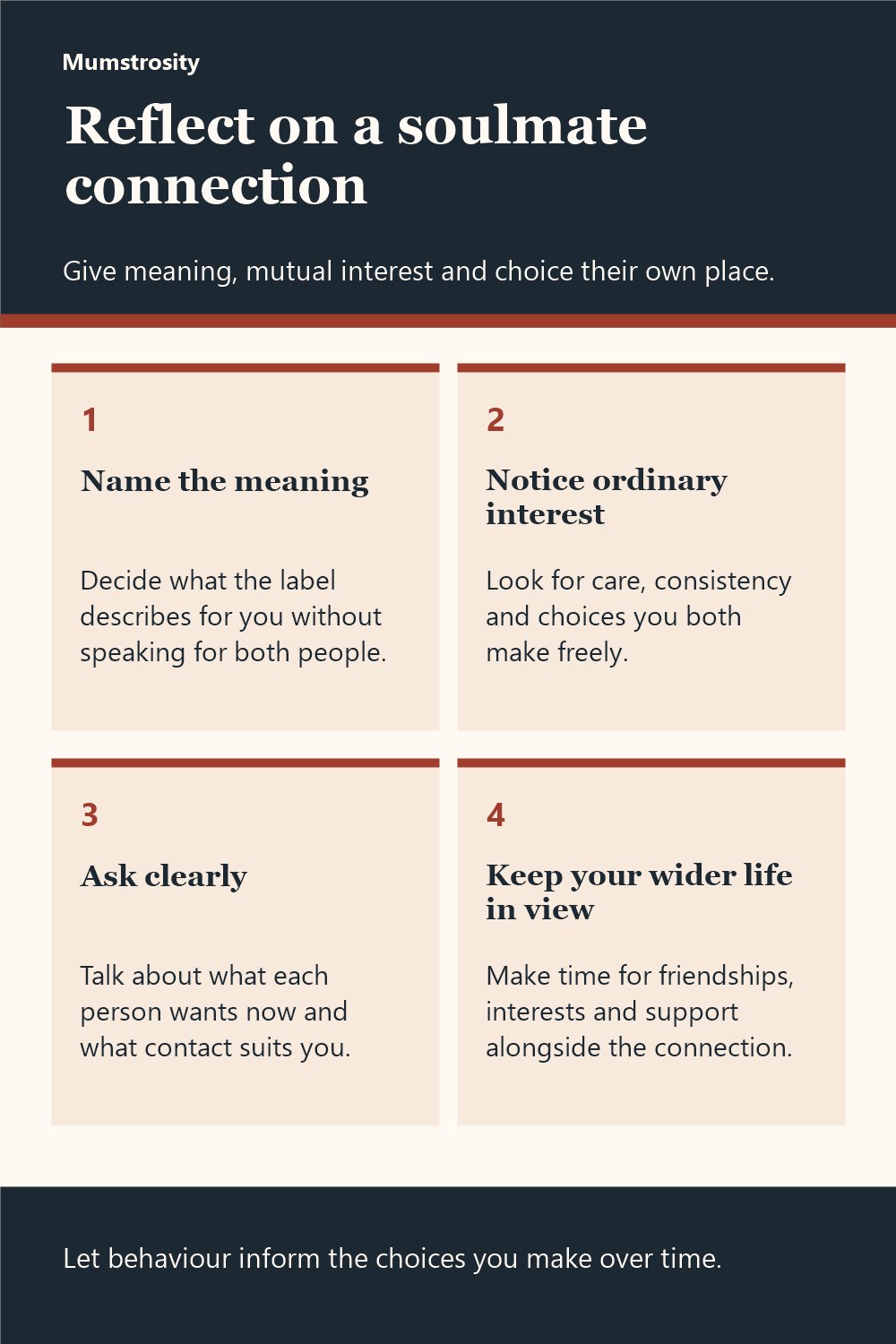
Reflect on a soulmate connection Give meaning, mutual interest and choice their own place.
- Name the meaning Decide what the label describes for you without speaking for both people.
- Notice ordinary interest Look for care, consistency and choices you both make freely.
- Ask clearly Talk about what each person wants now and what contact suits you.
- Keep your wider life in view Make time for friendships, interests and support alongside the connection.
Let behaviour inform the choices you make over time.