

Wanting reassurance does not make you unlovable, and enjoying independence does not prove that someone cares less. People differ in how much contact, affection and certainty they want. A useful conversation looks at the need and the response, rather than deciding who deserves the label “needy.”
Care can include listening, time together and dependable actions. It also needs room for a person to be unavailable, have other relationships and choose what they share. The question is how you can ask for connection while respecting both people’s limits.
On this page
Name the situation and the need
Begin with a recent moment rather than a verdict about yourself or your partner. Did a change of plan leave you unsure? Did you want comfort after a difficult day? Did a long gap between messages make it hard to know when you would next speak?
Try separating the event from the meaning you gave it. “We had not made a plan to talk” is different from “I do not matter.” The feeling is real, but the conclusion may need a conversation rather than a test of how quickly your partner responds.
You can also notice what kind of reassurance would help. Sometimes it is a practical answer about plans. Sometimes you want someone to listen. A clear need is easier to discuss than a request for the other person to make every uncertainty disappear.
Make a request someone can answer
A specific request gives your partner room to respond honestly. You might ask, “Could we arrange a short call tomorrow?” or “Would you listen for a few minutes before offering advice?” These are examples to adapt to your circumstances, not rules every couple must follow.
Be clear about the difference between asking and insisting. The other person may be willing, may suggest another time or may be unable to offer what you want. A respectful response takes your need seriously even when the answer is not yes.
When you are the person receiving a request, offer what you can realistically sustain: “I can talk after dinner, but I cannot message during my shift.” You do not have to promise constant availability to show care.
After a disagreement, reassurance may need an action as well as kind words. If a plan was repeatedly forgotten, agreeing how to keep track of it may answer the concern more usefully than saying that the other person worries too much.
Keep room for privacy and separate lives
Discuss the kind of contact that fits work, sleep, parenting and other commitments. An arrangement should have room for ordinary delays and changes. If a plan stops working, revisit it instead of treating it as a permanent test of love.
Time with friends, private thoughts and interests outside the relationship can matter to either person. There is no universal rule about how often you should go out separately or how much of your past you must disclose. Talk about the issue that actually affects you.
The love is respect guide to boundaries and expectations offers a way to discuss personal limits and shared expectations. Neither partner should be pressured into changing a boundary to prove devotion.
Affection also needs a choice. Ask whether a hug, quiet company or some space would feel helpful. Touch or sex should not become a requirement for comforting someone or showing that the relationship is secure.
Notice when reassurance becomes pressure
A strong feeling does not excuse monitoring, threats or punishment. Repeatedly demanding passwords, stopping a partner from seeing friends or retaliating when they cannot reply turns a request for connection into a problem that needs attention.
If you notice yourself doing this, pause the behaviour and take responsibility for the specific action. An apology is more useful when it includes a change you can follow through on. Seek individual support if you are struggling to stop checking, accusing or pressuring someone.
If your partner is controlling or frightening you, you do not have to manage their feelings before protecting your own safety. Confidential support can help you consider options without requiring a joint confrontation.
Review what helps and widen your support
After trying an arrangement, ask whether it is useful to both of you. Did the planned call help? Were the expectations realistic? Has the underlying issue changed, or are you repeatedly having the same conversation without a change in behaviour?
Support can come from more than one place. A trusted friend, a familiar activity or a qualified professional may offer something different from a partner. You do not have to manage every concern alone, and one person cannot always meet every need.
If worry feels overwhelming or is affecting daily life, consider speaking with a healthcare professional. You can seek support while still asking for respectful treatment in your relationship.
Sometimes the issue is a difference in what each person wants or can offer. You can acknowledge that difference and decide whether the relationship works for you, without declaring either person incapable of love.
Read the infographic in text
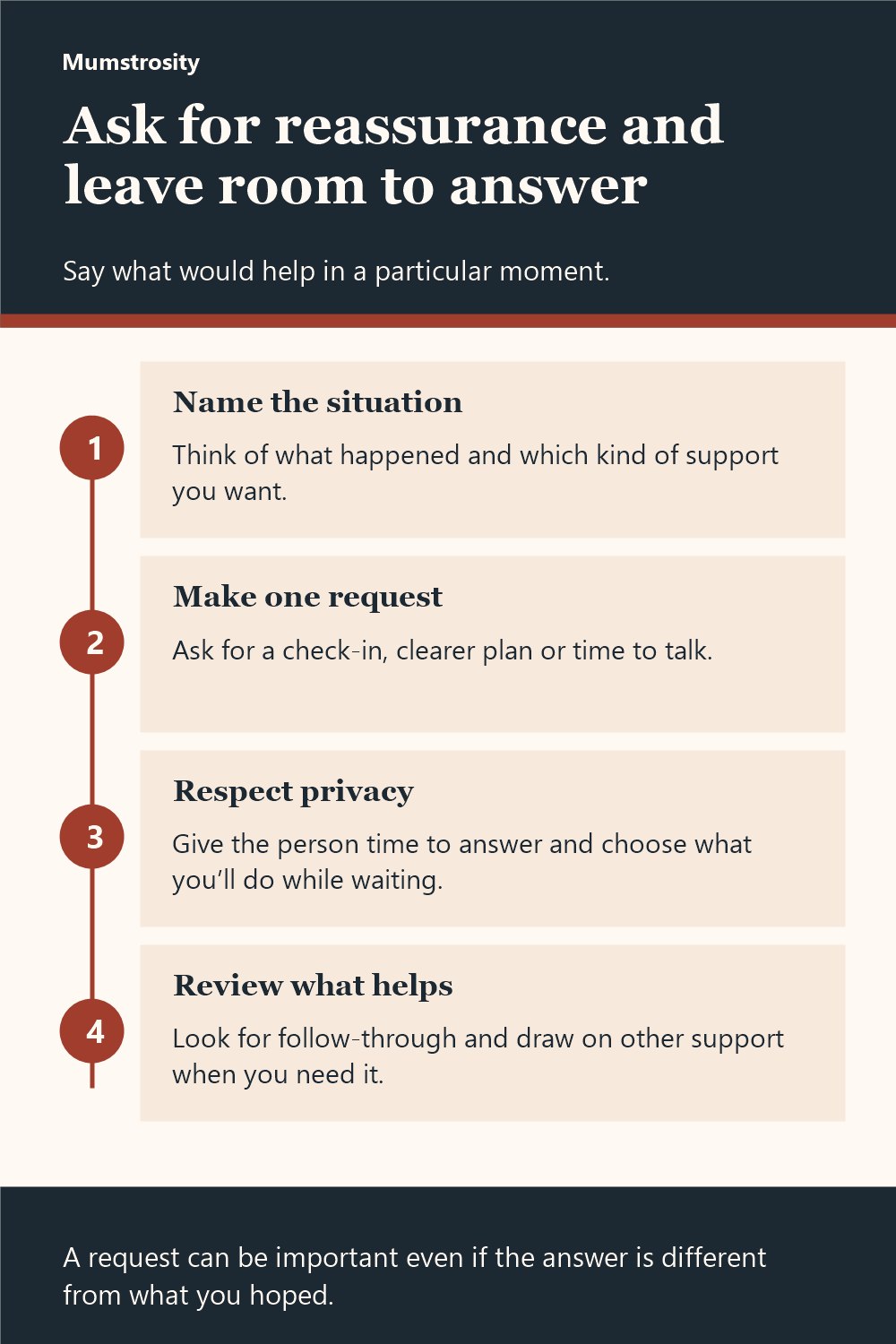
Ask for reassurance and leave room to answer Say what would help in a particular moment.
- Name the situation Think of what happened and which kind of support you want.
- Make one request Ask for a check-in, clearer plan or time to talk.
- Respect privacy Give the person time to answer and choose what you’ll do while waiting.
- Review what helps Look for follow-through and draw on other support when you need it.
A request can be important even if the answer is different from what you hoped.