

Repeated arguments can leave you tired, watchful or unsure how to raise an ordinary concern. The aim is not to eliminate every disagreement. It is to understand what keeps happening, make room for both people’s needs and notice whether the relationship allows respectful choices.
You cannot change a pattern by communicating for both people. A pause, a clearer request or a different agreement may help when both partners participate. Threats, intimidation and fear call for attention to safety, rather than a better argument technique.
On this page
1. Check whether the conversation is safe
Ask whether you can disagree, decline a request or leave a conversation without being threatened or punished. A disagreement about household tasks is different from someone blocking a doorway, destroying belongings, monitoring you or pressuring you into sex.
If you feel afraid or controlled, consider speaking privately with a domestic abuse service or someone trustworthy. Use a safer device or contact method if yours may be monitored. You do not have to confront the person alone or prove that the situation is serious before seeking support.
In immediate danger, contact local emergency services when you can safely do so. For other situations, support can help you consider options that fit your circumstances, including practical responsibilities and any children involved.
Love is respect’s conflict-resolution guide distinguishes ordinary disagreement from personal attacks and fear of retaliation. Communication exercises are most useful where both people can participate freely.
2. Name one pattern and one request
Choose a recent example rather than a verdict on your partner’s character. “We have changed the childcare plan at the last minute three times” gives you something specific to discuss. “You never care about anyone” is much harder to respond to constructively.
Describe the practical effect and what you need next: “I had to leave work early. Can we agree who confirms the collection plan and when?” The request may involve a different arrangement, clearer notice or an honest statement that the current plan is not manageable.
Keep the first conversation focused. If several concerns connect, write them down privately and choose where to begin. You can return to another issue later instead of trying to settle every disappointment in one sitting.
3. Make room to speak and listen
Choose a time when you both have enough attention for the subject. Ask whether now works and explain what you want to discuss. A difficult conversation does not have to begin immediately because one person is ready.
Listen for the other person’s actual concern, then check your understanding: “Are you saying you need more notice before I change plans?” Understanding a preference does not require agreeing to it. Both people can explain limits and consider alternatives.
Use the communication method that is accessible and safe for both of you. A short written message may help organise a practical issue or give someone time to process it. Face-to-face discussion is not automatically better. Avoid sending a stream of accusations or demanding instant replies through any channel.
Take responsibility for your own actions without assuming all harm must be shared equally. “I interrupted and will let you finish” can be appropriate. You do not have to accept blame for another person’s threats or mistreatment to show that you are listening.
4. Pause with a workable plan
If the conversation becomes too heated to continue usefully, suggest a pause: “I want to return to this, but I need a break. Could we try again after dinner?” Agree on a realistic time or a way to arrange the next conversation.
A pause should give each person room to settle, rather than become a punishment or a demand to chase the other person. Respect a request for space. Keep necessary practical communication clear, and avoid following someone from room to room or continuing the argument by text.
A longer relationship break needs a separate conversation where possible. Clarify contact, living arrangements, responsibilities and whether either person is agreeing to exclusivity. Time apart does not automatically repair the issue, and neither person has to promise reconciliation before considering what they need.
5. Review what actually changes
After a discussion, make the agreement concrete. Who will do what, and when will you review whether it works? For example, trying a shared weekly planning conversation gives you something observable to evaluate.
Notice follow-through as well as apologies. Are concerns heard, plans carried out and difficulties discussed? You may need to revise an arrangement, accept a difference or acknowledge that you want incompatible things. A calm conversation alone does not establish that the underlying problem is resolved.
When conversations repeatedly stall, individual support may help you think through your needs and choices. If both people can participate safely and want help, you can explore suitable relationship counselling. Fear or coercion deserves specialist support when considering what is safe.
You can choose to continue, change an arrangement or end a relationship. The useful question is whether the pattern is becoming more respectful and workable, not whether you can learn to tolerate every argument.
Read the infographic in text
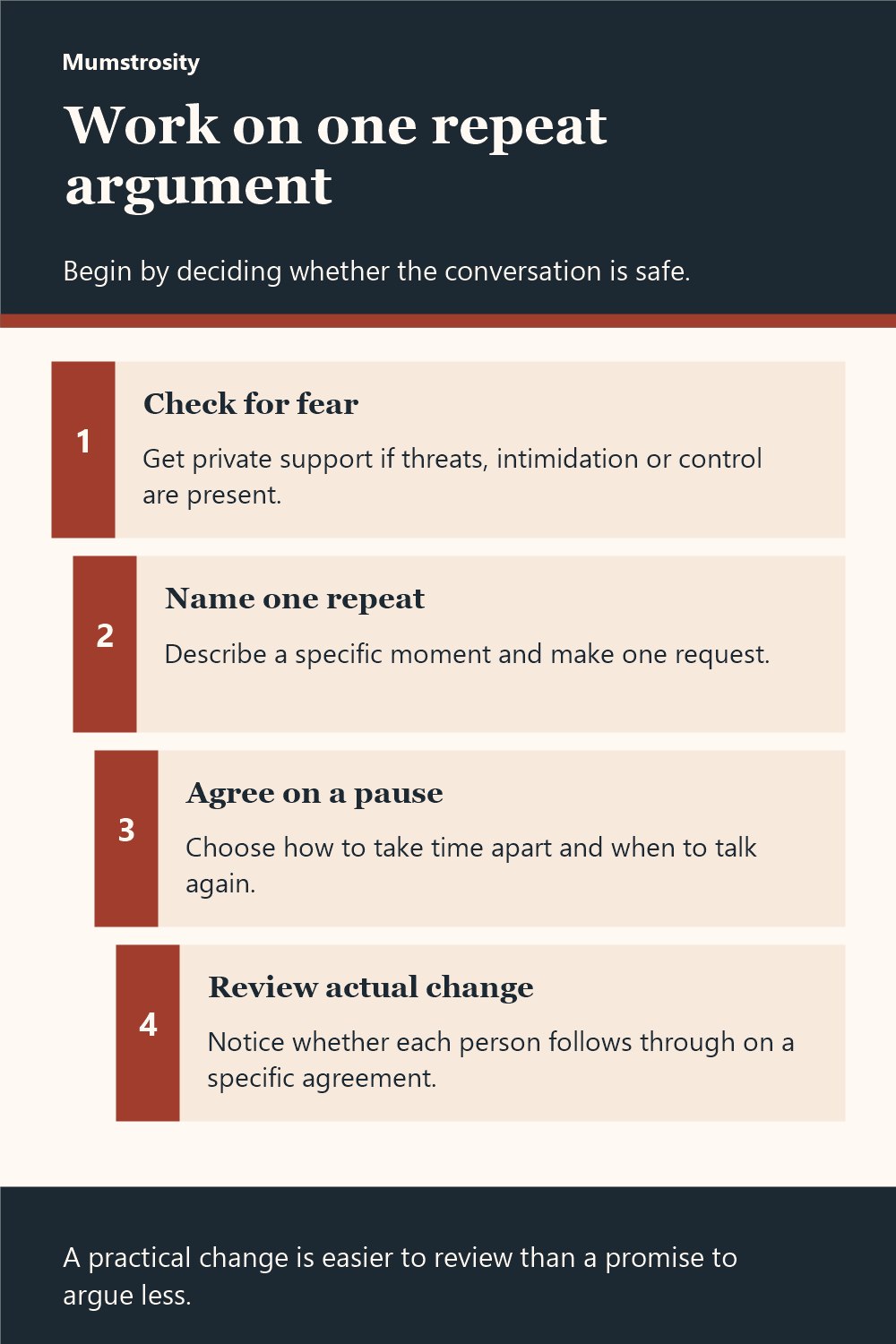
Work on one repeat argument Begin by deciding whether the conversation is safe.
- Check for fear Get private support if threats, intimidation or control are present.
- Name one repeat Describe a specific moment and make one request.
- Agree on a pause Choose how to take time apart and when to talk again.
- Review actual change Notice whether each person follows through on a specific agreement.
A practical change is easier to review than a promise to argue less.