

Feeling “played” can mean that someone made promises they did not keep, hid something important or accepted your care while repeatedly disregarding your needs. The label may capture your hurt, but describing what happened can make your next choice clearer.
You do not have to prove that someone planned to use you before changing an arrangement that hurts. Your kindness did not make their dishonesty acceptable, and being upset does not mean you have lost your strength.
If there are threats, stalking, coercion or fear of retaliation, put safety before a confrontation. A domestic abuse service can help you consider safer contact and practical arrangements.
On this page
1. Name the behaviour and its impact
Start with a concrete example: “They asked me to cancel my plans, then repeatedly failed to turn up,” or “We agreed to be exclusive, and I learned that agreement was not being kept.” Separate what you know from what you suspect.
Inconsistent contact alone cannot tell you a person’s motives. A broken agreement, deception or a refusal to discuss your needs gives you something more specific to address. You can also decide that a relationship does not suit you without finding wrongdoing.
When you doubt your own judgment
Ask what was agreed, what happened and what it cost you in time, energy or practical responsibilities. If safe and useful, make a private note rather than repeatedly checking messages for a hidden explanation. You do not need to investigate their devices or gather a perfect case.
2. Leave blame where it belongs
Trusting someone or wanting a relationship to work does not make you responsible for their choices. Nor does accepting support from others require you to tolerate being mistreated in return.
You can reconsider how much you give without becoming uncaring. Our article on kindness without a perfection test explores how good intentions can sit alongside limits and ordinary difficult feelings.
Notice changes without judging yourself
You might feel angry, embarrassed, numb or reluctant to meet someone new. There is no single reaction you must have. If this is affecting sleep, daily tasks or your sense of safety, consider support from a qualified professional rather than waiting to feel “strong enough” alone.
3. Choose one boundary you can act on
A boundary describes what you are available for and what you will do. For example: “I won’t rearrange childcare for a last-minute invitation,” or “If you insult me during a call, I will end the conversation.” Choose words that fit your situation.
Where it is safe to discuss the issue, make a specific request and leave room for a clear answer. “Are you willing to agree plans by Friday?” is easier to assess than asking someone to prove they care. Their answer may still be disappointing.
When a limit leads to pressure
A boundary cannot make another person behave safely. If they respond with threats, monitoring or intimidation, seek individual specialist support. The National Domestic Violence Hotline’s safety-planning guidance considers safety while experiencing abuse, preparing to leave and after leaving. Use a safer device or another way of reaching help if yours may be monitored; for immediate danger, contact local emergency services.
4. Decide what contact works for you
You might want a pause, a conversation about one issue, contact limited to necessary arrangements or an end to the relationship. You do not owe someone continued access simply because they want another chance.
If contact is safe, you could say, “I need some time without relationship conversations. I’ll contact you when I’m ready to discuss the shared arrangements.” You can choose a different approach if sending that message would increase risk.
Plan around shared responsibilities
Children, housing, work and finances can make distance complicated. Think about the next practical task: a pickup, a payment or returning an item. Seek suitable local legal or financial advice for agreements that need it. Avoid assuming that immediately blocking every channel will be workable or safe.
5. Make support specific
Ask for something another person can understand: “Could you listen without contacting them?” or “Can you help me think through this week’s arrangements?” Choose someone who respects your privacy and decisions.
Keep room for ordinary care and other connections. The NHS guidance on relationships and wellbeing suggests protecting your limits, making time for your own interests and talking with someone you trust. You do not have to resolve the whole relationship before taking a break or accepting company.
Learn without turning hurt into an obligation
You may eventually notice a request you want to make earlier or an agreement you want to clarify. That does not mean you caused the harm or needed it to become wiser. You are allowed to want support without finding a positive lesson.
6. Let trust develop through actions
If you freely want to consider repair, look for responsibility, respect for your pace and sustained follow-through. An apology or an intense conversation does not require you to restore the old arrangement.
The same applies when meeting someone new. Keep your friendships, responsibilities and preferences in view. You can share more over time as you see how the person handles an ordinary disagreement or a changed plan.
Practise a clear answer
A simple “I can’t do that this week” can be enough. You do not need to set a trap, make someone jealous or perform indifference to test their feelings. Notice whether your answer is respected and whether care is mutual.
7. Choose a manageable next step
For today, choose one action: keep an existing plan, ask a trusted person for company, arrange professional support or decide what contact you can manage. If you are unsure, it is reasonable to pause a decision while getting help with the immediate concern.
You can remain kind and still leave an arrangement that repeatedly hurts. Your next choice does not have to establish whether the other person is entirely good or bad; it can simply protect what you need now.
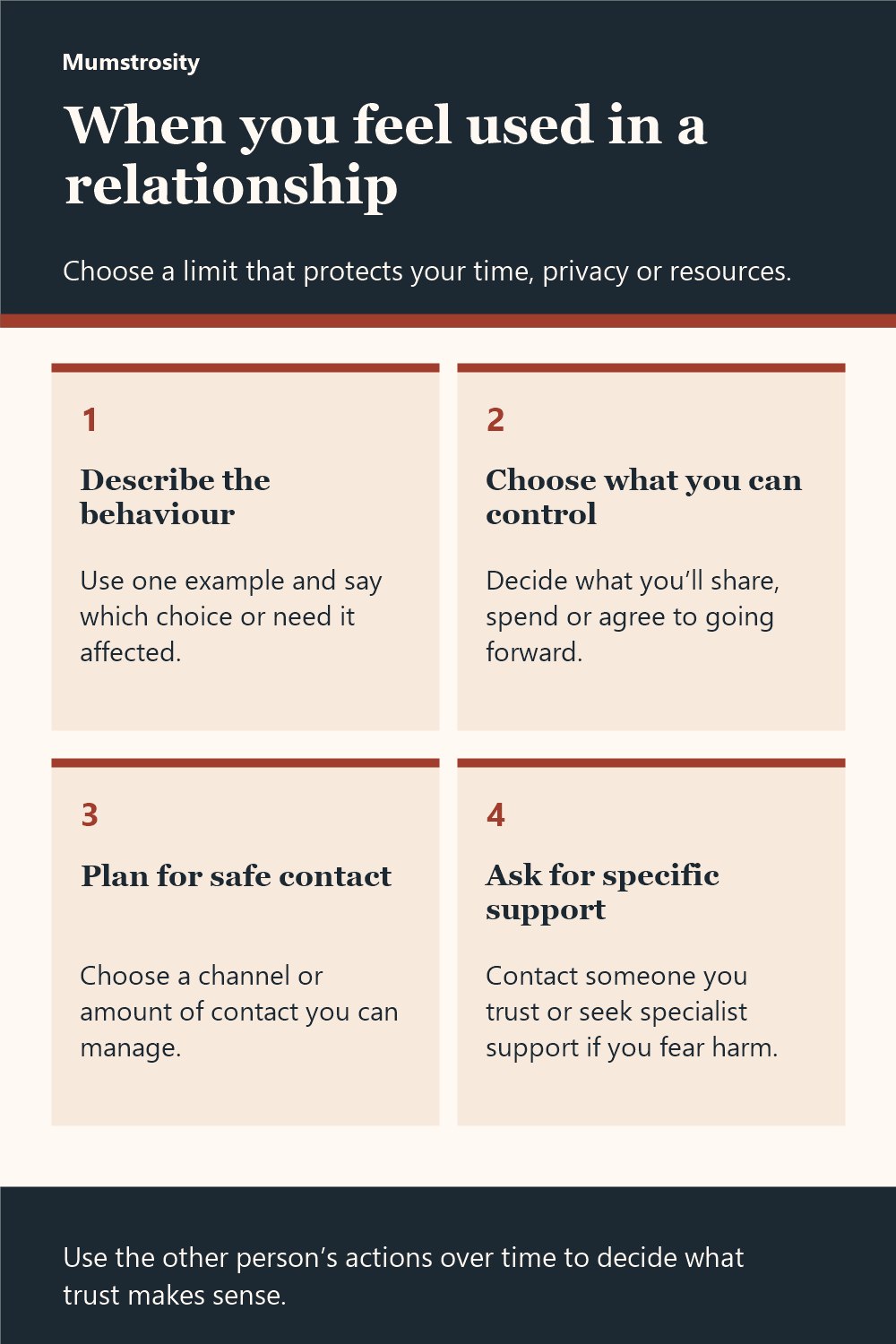
Read the infographic in text
When you feel used in a relationship Choose a limit that protects your time, privacy or resources.
- Describe the behaviour Use one example and say which choice or need it affected.
- Choose what you can control Decide what you’ll share, spend or agree to going forward.
- Plan for safe contact Choose a channel or amount of contact you can manage.
- Ask for specific support Contact someone you trust or seek specialist support if you fear harm.
Use the other person’s actions over time to decide what trust makes sense.