

You can enjoy a close relationship and still have private thoughts, friendships and time of your own. You do not have to become difficult to reach or make a partner uncertain to protect that space.
Focus on an arrangement you can both understand: when you are available, what you want to share and how you make decisions. These ten ideas offer practical ways to balance connection with the rest of your life.
On this page
- Plan time together and apart
- Make invitations without keeping a score
- Agree on workable expectations for replies
- Keep friendships and interests in your week
- Decide about last-minute plans individually
- Say what you are available for
- Choose privacy without creating mystery
- Leave room for respectful disagreement
- Ask for support without judging your worth
- Choose commitment through an explicit agreement
1. Plan time together and apart
Start with the week you actually have: work, rest, caring responsibilities, friends and time you would enjoy sharing. You can want closeness and also want an evening to yourself.
Ask for a plan you can discuss: “I would enjoy dinner on Friday, and I am keeping Saturday for my own plans.” Neither person needs to be constantly available to show care. Return to the arrangement if it regularly leaves one of you without enough rest or connection.
2. Make invitations without keeping a score
Sending the first message does not make you less valued. Nor do exactly equal numbers of calls establish a fair relationship. People can contribute differently while still showing interest and following through.
Notice whether plans and effort are broadly shared over time. If you feel you are always initiating, say what you would like: “Could you choose our next plan?” Deliberately withholding contact to make someone chase you may leave the actual difference unexplained.
3. Agree on workable expectations for replies
You can answer a message when you have room to respond. Explain relevant limits instead of expecting your partner to infer them: “I cannot check my phone during work; I usually reply in the evening.” Ask about their circumstances too.
Discuss how to handle an urgent practical matter separately from ordinary conversation. A different reply speed is not, by itself, a measure of affection. If the level of contact does not meet your needs, talk about the difference or reconsider the arrangement.
4. Keep friendships and interests in your week
Make room for people and activities that matter to you. A relationship can be important without becoming your only source of company, meaning or support. You can also choose to enjoy an activity separately even when your partner likes it.
When plans overlap, consider what you have already agreed and what you can realistically change. Avoid repeatedly cancelling on others just because a partner becomes available. An occasional change can be a choice; an ongoing expectation deserves a conversation.
5. Decide about last-minute plans individually
A spontaneous invitation can be welcome when it suits you. You do not need a universal rule against last-minute plans, and you do not have to accept them when they disrupt something important.
You might say, “I cannot change tonight’s arrangements, but I can meet on Sunday.” You can also decline without offering another date. Consider whether both people can hear an answer freely, including when the answer is disappointing.
6. Say what you are available for
Put a limit into words you can act on: “I need quiet time after work,” or “I can listen for a while, but I cannot stay on the phone all evening.” The aim is to explain your capacity and choices.
The love is respect guide to boundaries discusses comfort, privacy and how you want to be treated. A limit about your own time should leave room for another person’s choices; it should not become an instruction to abandon their friends or interests.
7. Choose privacy without creating mystery
You do not need to share every passing thought, password or private conversation. You can say, “I am still thinking about that,” or “That experience is personal, and I am not ready to discuss it.”
Be honest about matters that affect shared agreements. Privacy should not be used to conceal breaking an exclusivity agreement or to keep someone uncertain so they work harder for your attention. Explain what you can share and let the other person decide whether the arrangement works for them.
8. Leave room for respectful disagreement
Different opinions can coexist with care. You do not need to create conflict to make a relationship stronger, or agree with everything to keep the peace. Focus on the particular issue and what each person needs.
If a conversation becomes difficult, a pause and an agreed time to return may help. Threats, intimidation or punishment for saying no call for a response focused on safety and support. Being clearer about a boundary cannot make someone else behave safely.
9. Ask for support without judging your worth
Needing reassurance, practical help or company does not make you unattractive or undeserving of a relationship. Describe what would help, and allow the other person to be honest about what they can offer.
Keep more than one source of support where possible. A trusted friend, community connection or suitable professional may help with a particular concern. Someone else remains responsible for their mistreatment; your confidence or independence does not determine whether you deserve respect.
10. Choose commitment through an explicit agreement
There is no single timetable that makes commitment healthy. Discuss what you are choosing, whether you both want it and whether either person can slow down or decline without pressure.
You might ask, “What would being exclusive mean to each of us?” Then consider what happens in daily life. You can keep building the relationship, change an agreement or step back. Closeness and independence become practical through choices you can both understand.
Read the infographic in text
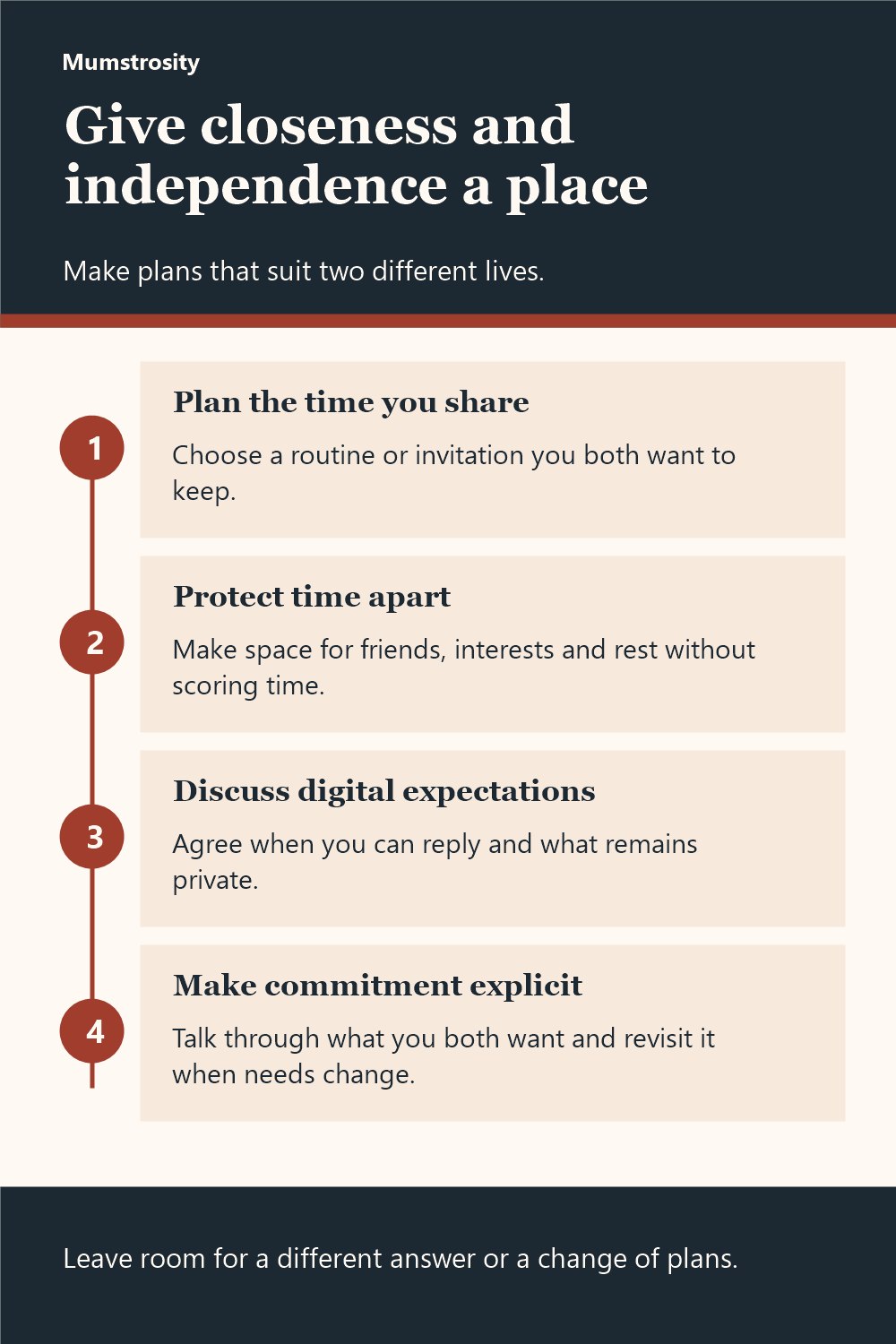
Give closeness and independence a place Make plans that suit two different lives.
- Plan the time you share Choose a routine or invitation you both want to keep.
- Protect time apart Make space for friends, interests and rest without scoring time.
- Discuss digital expectations Agree when you can reply and what remains private.
- Make commitment explicit Talk through what you both want and revisit it when needs change.
Leave room for a different answer or a change of plans.