

Concern about a partner’s honesty can leave you reviewing every gesture and message. Take the concern seriously while separating what you know from what you suspect. A nervous manner, a private phone or an uneasy feeling cannot, on its own, establish that someone is lying.
Begin with the particular statement or agreement that matters. Clear questions, information you can legitimately check and your own limits offer a more useful starting point than trying to decode someone’s face.
On this page
- Name the particular concern
- Avoid judging truth by body language
- Distinguish privacy from a broken agreement
- Ask one clear question
- Keep the conversation freely chosen
- Identify the answer you actually need
- Consider consistency over time
- Respond to an established falsehood specifically
- Notice how your concern is treated
- Choose a limit you can carry out
- Seek support and decide what works for you
1. Name the particular concern
Describe what happened before deciding what it means. “We agreed to meet at six, and you later said we had never made a plan” is more specific than “You always lie.” Separate the statement, the information you have and what remains uncertain.
A concern may deserve an answer without proving deliberate deception. Start with the issue that affects your choices now.
2. Avoid judging truth by body language
Looking away, fidgeting or speaking quickly cannot establish that a particular statement is false. People’s behaviour has many possible explanations, and familiarity does not give you a dependable lie detector.
A review of nonverbal communication and deception describes the weakness and unreliability of such cues. Focus your question on the account itself instead of demanding eye contact or a particular manner of speaking.
3. Distinguish privacy from a broken agreement
A partner can have private messages, personal memories and time alone. Keeping a phone out of view does not by itself establish dishonesty. Ask what information is relevant to an agreement you actually share.
For example, whether you have agreed to be exclusive matters to both people. That is different from expecting an account of every conversation or unlimited access to someone’s device.
4. Ask one clear question
If it feels safe to discuss the concern, choose a specific question: “Yesterday you said the booking was cancelled; today you said you went. Can you help me understand the difference?” Allow room for an explanation before deciding what to do.
A religious expression, solemn promise or confident tone does not settle whether an account is accurate. Return to the particular information you need.
5. Keep the conversation freely chosen
Neither person needs to continue a conversation through exhaustion, intimidation or unwanted affection. If the topic changes, you can ask whether you can return to it at an agreed time.
Affection or sex should remain welcome to both people. You do not need to accept physical contact to keep the peace, and you cannot require an immediate answer by blocking someone from leaving.
6. Identify the answer you actually need
Decide what affects your next choice. You may need to know whether a plan is confirmed, whether a shared agreement is still wanted or whether information you relied on was accurate.
Keep to information you can legitimately access. Searching devices without permission or recruiting friends to monitor someone can add another breach of trust without resolving the original issue.
7. Consider consistency over time
A changed detail may reflect an error, a misunderstanding or dishonesty; the detail alone does not choose among those explanations. Ask about a meaningful discrepancy rather than treating every variation as evidence.
If important agreements repeatedly change or questions remain unanswered, consider the effect on your life. You can decide an arrangement is unreliable without explaining every motive behind it.
8. Respond to an established falsehood specifically
If you know a statement was false, describe the effect and the change you would need. “I relied on that information to make my plans” gives you something concrete to address.
Notice whether the person takes responsibility, corrects the information and follows through. An apology does not require you to restore trust immediately or offer another chance. You can decide that the breach is enough to end the relationship.
9. Notice how your concern is treated
A person can disagree with your interpretation while still answering respectfully. Repeated insults, threats or pressure deserve attention regardless of whether you can establish the truth of every disputed detail.
A defensive response does not prove a lie. Equally, you do not have to dismiss the way you are being treated while waiting for certainty about a separate question.
10. Choose a limit you can carry out
You might stop relying on an unconfirmed plan, decline a shared commitment or take time before another relationship decision. Explain a safe, practical choice rather than setting a trap designed to obtain a confession.
For example: “Without a confirmed plan by Thursday, I will make other arrangements.” A boundary gives your own next step a shape; it does not guarantee a different answer from someone else.
11. Seek support and decide what works for you
Talk privately with someone who can listen without contacting your partner or taking over the decision. Our guide to feeling used in a relationship explores support and practical boundaries.
If raising the issue could bring threats or retaliation, seek confidential specialist support before a confrontation. You can continue, pause or leave a relationship without assembling a perfect case. Your need for clarity and respectful treatment matters alongside the question of what happened.
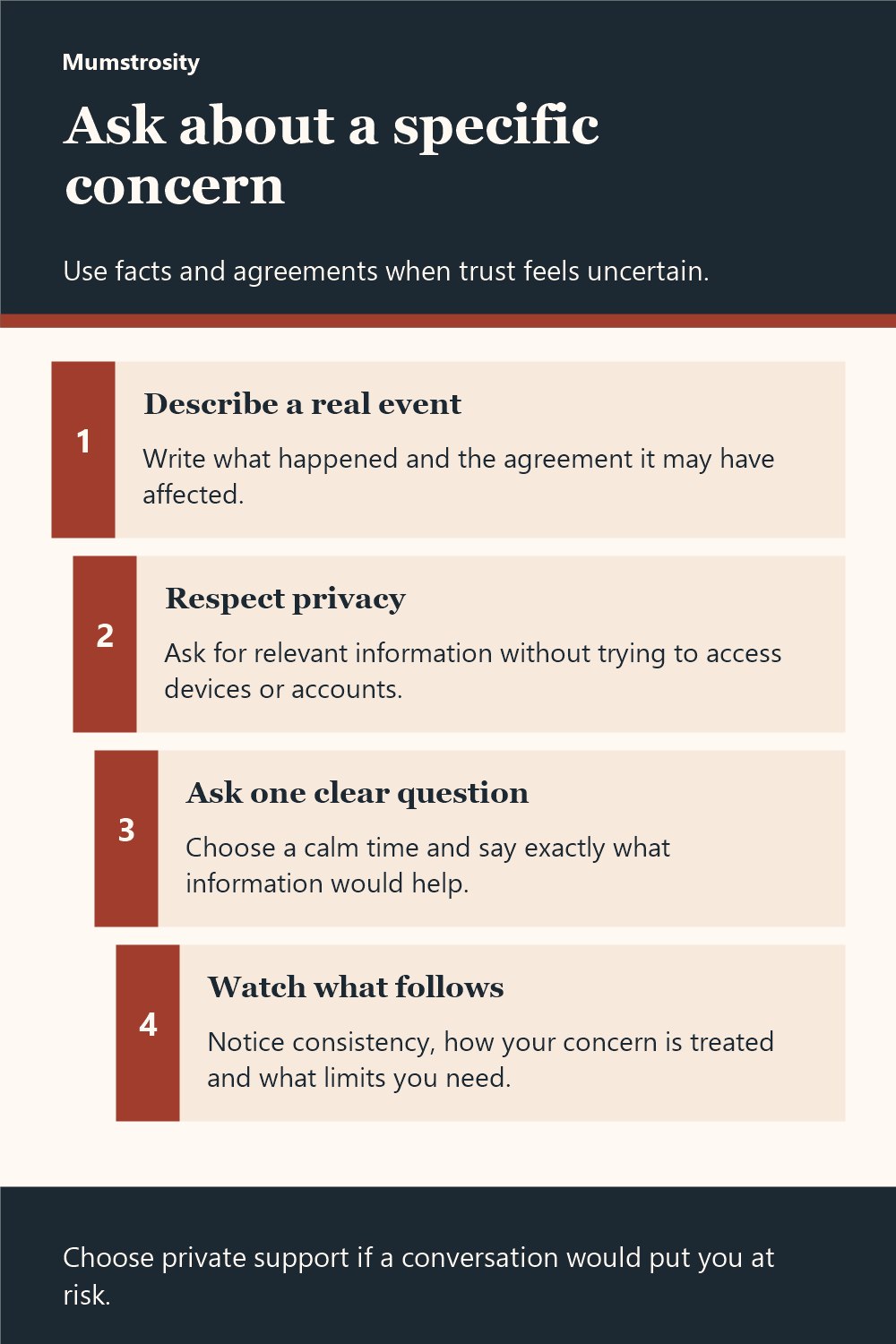
Read the infographic in text
Ask about a specific concern Use facts and agreements when trust feels uncertain.
- Describe a real event Write what happened and the agreement it may have affected.
- Respect privacy Ask for relevant information without trying to access devices or accounts.
- Ask one clear question Choose a calm time and say exactly what information would help.
- Watch what follows Notice consistency, how your concern is treated and what limits you need.
Choose private support if a conversation would put you at risk.