

Stories about relationships can be funny, unsettling, fantastical or full of social observation. Choosing a book by its mood and format can be more useful than deciding which love stories a particular gender is supposed to enjoy.
The five starting points below range from a Jazz Age novel to a space-opera comic. Each offers a different way to think about attraction, expectations or life together. Use the discussion prompts to explore the story, without treating fictional relationships as instructions for your own.
On this page
- Social drama: The Great Gatsby by F. Scott Fitzgerald
- Comedy: Jeeves and Wooster by P. G. Wodehouse
- Epic fantasy: The Name of the Wind by Patrick Rothfuss
- Graphic storytelling: Saga by Brian K. Vaughan and Fiona Staples
- Courtship and first impressions: Pride and Prejudice by Jane Austen
- Choose a starting point that fits your reading mood
1. Social drama: The Great Gatsby by F. Scott Fitzgerald
The Great Gatsby follows the wealthy, mysterious Jay Gatsby and his attachment to Daisy Buchanan in 1920s America. Wealth, appearances and the desire to recover the past complicate the relationships around them.
Choose it when you want a short, morally complicated social novel with romantic longing at its centre. It offers plenty to discuss about the difference between knowing a person and investing in an idea of them.
A question to discuss: When does remembering a relationship become an attempt to recreate it on your own terms?
2. Comedy: Jeeves and Wooster by P. G. Wodehouse
In the Jeeves and Wooster stories, Bertie Wooster repeatedly finds himself in social trouble, with Jeeves helping him untangle the consequences. Courtship, engagements, meddling relatives and misunderstandings provide material for the comedy.
The Inimitable Jeeves is one possible starting point if you enjoy linked comic episodes. Read for the language and farce as well as the romantic complications. The historical social world and its assumptions are part of what you may want to discuss.
A question to discuss: Who gets to decide whether a proposed match is a good one—the people involved or the people arranging it?
3. Epic fantasy: The Name of the Wind by Patrick Rothfuss
The Name of the Wind begins The Kingkiller Chronicle, an epic fantasy told through the life story of Kvothe. Romantic themes sit within a larger story of survival, ambition, music and the making of a legend.
Choose this when you want a substantial fantasy adventure with relationships among its concerns. The storytelling frame also offers room to consider how a narrator presents their own past.
A question to discuss: How does hearing a relationship described by one person affect what you think you know about everyone involved?
4. Graphic storytelling: Saga by Brian K. Vaughan and Fiona Staples
Saga, written by Brian K. Vaughan and illustrated by Fiona Staples, follows Alana and Marko, parents from opposing sides of a galactic war. Their relationship is part of a wider story about family and trying to survive a dangerous world.
Start with the first collected volume, which gathers issues 1–6. The publisher rates it M for mature readers. Its visual storytelling and science-fiction/fantasy setting offer a different reading experience from a prose novel.
A question to discuss: How do the pressures surrounding a family affect the choices its members are able to make?
5. Courtship and first impressions: Pride and Prejudice by Jane Austen
Pride and Prejudice follows Elizabeth Bennet, Fitzwilliam Darcy and a social world shaped by courtship, family expectations and first impressions. Austen’s comedy of manners gives readers room to examine how quickly people form judgements.
Choose it if you enjoy conversation, social observation and characters revising what they thought they knew. It can also prompt discussion about the expectations other people bring to a relationship.
A question to discuss: What makes a changed opinion of someone convincing: an explanation, an action, or time to see both?
6. Choose a starting point that fits your reading mood
Consider whether you want comedy, social drama, a long fantasy adventure or a comic. A sample chapter or first issue can help you decide whether the style appeals to you. For a series, begin with the first book or collection and check the reading order on the publisher’s page.
If you are sharing the reading with someone, agree on a manageable amount and one question to discuss. Different interpretations can make the conversation interesting; you do not have to reach a single correct view of every character.
You can enjoy a compelling fictional romance while making different choices in life. Our guide to everyday relationship practices considers practical care, privacy and room to choose in real relationships.
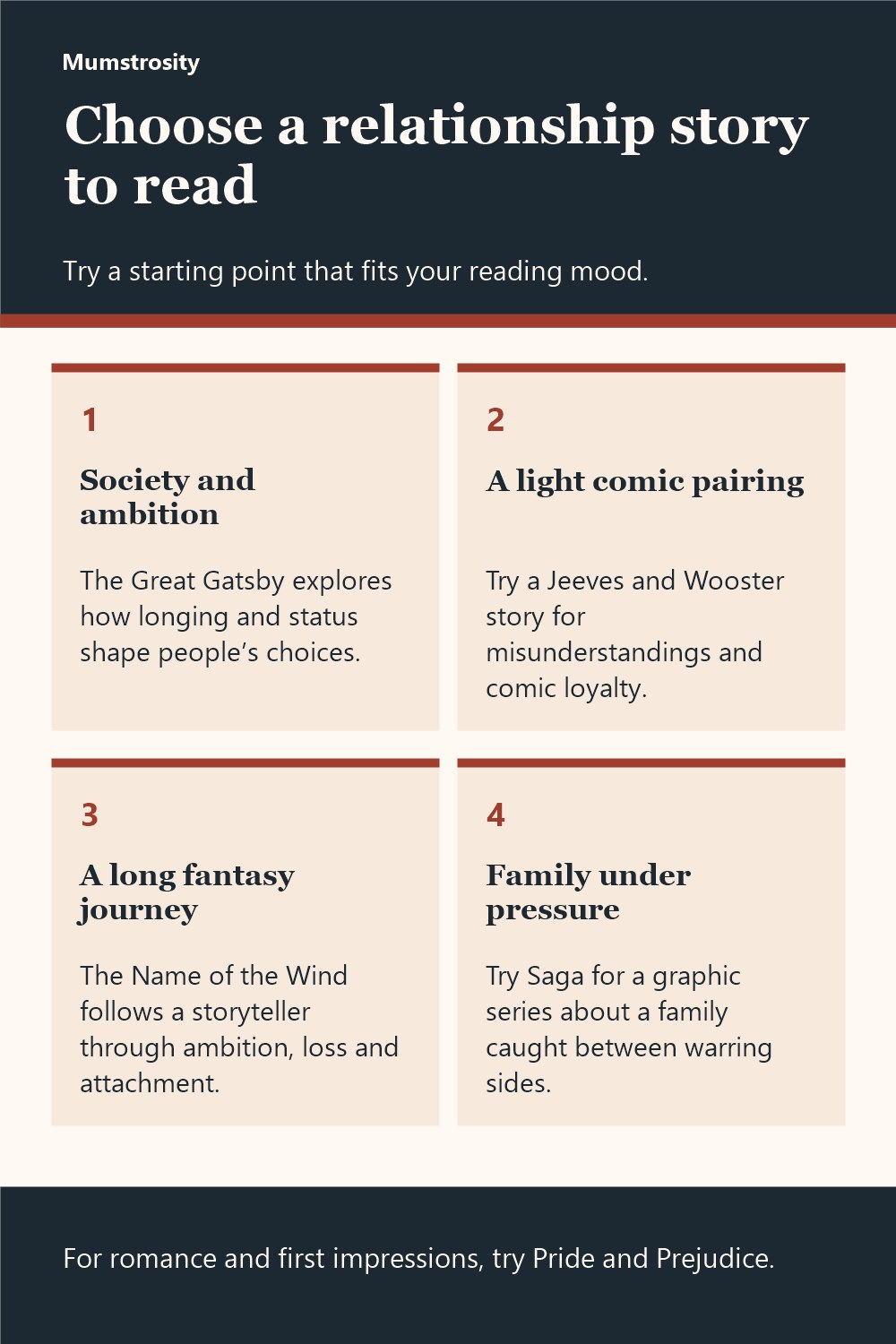
Read the infographic in text
Choose a relationship story to read Try a starting point that fits your reading mood.
- Society and ambition The Great Gatsby explores how longing and status shape people’s choices.
- A light comic pairing Try a Jeeves and Wooster story for misunderstandings and comic loyalty.
- A long fantasy journey The Name of the Wind follows a storyteller through ambition, loss and attachment.
- Family under pressure Try Saga for a graphic series about a family caught between warring sides.
For romance and first impressions, try Pride and Prejudice.