

A relationship can last a long time and still leave someone unhappy or restricted. When you ask what makes a relationship work, consider the experience of both people: whether you can choose freely, feel respected and make arrangements that fit your lives.
These thirteen practices are discussion prompts, not a score or a promise that a relationship will last. You can try a useful change while keeping room to reconsider whether the relationship is right for you.
On this page
- Choose the relationship freely
- Keep expectations specific and realistic
- Show respect when you differ
- Talk without demanding complete access
- Share care without becoming responsible for every feeling
- Leave room for separate interests
- Revisit plans as circumstances change
- Handle disagreement without intimidation
- Repair harm without requiring forgiveness
- Notice everyday ways to connect
- Make affection and intimacy voluntary
- Make practical agreements and review them
- Reassess with support when needed
1. Choose the relationship freely
Ask whether you want this relationship as it is, rather than feeling you must stay because of pressure, status or fear of being single. Practical ties can make decisions complicated, but they do not erase your wishes. Both people should have room to choose whether to continue.
2. Keep expectations specific and realistic
No partner can anticipate every need or remove every difficulty. Talk about the things that affect daily life: contact, affection, money, household tasks or future plans. An expectation becomes easier to assess when you can describe what it would look like in practice.
Accepting ordinary imperfections does not require you to accept repeated harm. A difficult period is a reason to look at what is happening, not proof that enduring it will make the relationship stronger.
3. Show respect when you differ
Respect includes taking another person’s views and limits seriously, even when you want a different outcome. You can disagree, ask for change or decide that something will not work for you. Insults, humiliation and treating a partner as less entitled to a voice do not become acceptable because the subject matters deeply.
4. Talk without demanding complete access
Choose a safe time to raise a specific concern, then listen to the answer. “I felt left out when the plan changed without telling me” gives you an issue to discuss. Try to understand what each person needs before rushing to a verdict.
Honesty is compatible with privacy. You do not have to share passwords, surrender private conversations or disclose an experience before you are ready to prove that you can be trusted.
5. Share care without becoming responsible for every feeling
Ask what support would be useful instead of assuming you must solve everything. Sometimes that may mean listening or taking on a practical task. At other times, someone may want space or help beyond the relationship.
You do not have to be happy or free of personal difficulties to deserve care. Equally, loving someone does not make you responsible for managing every emotion or accepting every demand.
6. Leave room for separate interests
Discuss time together and time apart without making independence a test of loyalty. Friendships, hobbies, rest and personal routines can continue alongside a relationship. Neither person needs to grant the other permission to have an identity of their own.
Choose arrangements that suit you rather than copying a rule about how many holidays, accounts or activities couples should share. The useful question is whether both people can make choices without fear.
7. Revisit plans as circumstances change
Work, caring responsibilities, interests and beliefs may change. Check whether old agreements still fit. You might need to redistribute tasks, change how often you see each other or discuss a different future.
Respecting someone’s growth does not mean promising that every change will be compatible with your own wishes. You can acknowledge a difference honestly and consider its effect on the relationship.
8. Handle disagreement without intimidation
Focus on the issue rather than attacking character. If a conversation becomes too heated, a pause can be useful when it is safe and both people understand whether and when you will return to it. Returning matters more than insisting on resolving everything immediately.
Love is respect’s conflict-resolution guidance distinguishes ordinary disagreement from personal attacks and fear of retaliation. A disagreement does not make coercion or threats a shared communication problem.
9. Repair harm without requiring forgiveness
Acknowledge the specific action, its effect and what needs to change. Avoid an apology that makes the other person responsible for your behaviour. Then look for consistent follow-through.
The person hurt can need time, decline forgiveness or decide to leave. Repair is something people may choose to explore together; it is not an entitlement created by saying sorry.
10. Notice everyday ways to connect
Ask what feels welcome rather than assuming every romantic gesture will be enjoyed. A walk, a shared meal, a thoughtful message or help with an agreed task may matter. Keep gestures proportionate to the person’s preferences and your circumstances.
Small acts of care can be meaningful, but gifts and affection do not cancel out harmful behaviour or replace a conversation about an ongoing problem.
11. Make affection and intimacy voluntary
Talk about the kind of closeness each person wants. Sexual activity is not required for every relationship, and a change in desire cannot, by itself, tell you whether a relationship is good or bad.
Either person can decline an activity or change their mind. Love is respect’s physical-boundaries guidance explains that intimacy is not something a partner owes. Choose affection that is freely welcomed, without pressure to reassure someone.
12. Make practical agreements and review them
Talk concretely about shared decisions: who does which tasks, how plans are made, and which expenses or responsibilities you share. Aim for an arrangement both people understand rather than assuming care will make the details work themselves out.
Try one manageable change and agree a time to review it. If the arrangement repeatedly falls to one person to organise and enforce, include that effort in the discussion too.
13. Reassess with support when needed
Notice what is improving, what remains difficult and what you want now. A relationship ending does not mean the people involved failed to love hard enough. Some differences cannot be resolved in a way that suits both people.
If you are weighing another attempt, consider what another chance would require. If you fear threats, control or violence, seek private support from a domestic abuse service before confronting your partner. You are allowed to prioritise your safety and your own choice.
Read the infographic in text
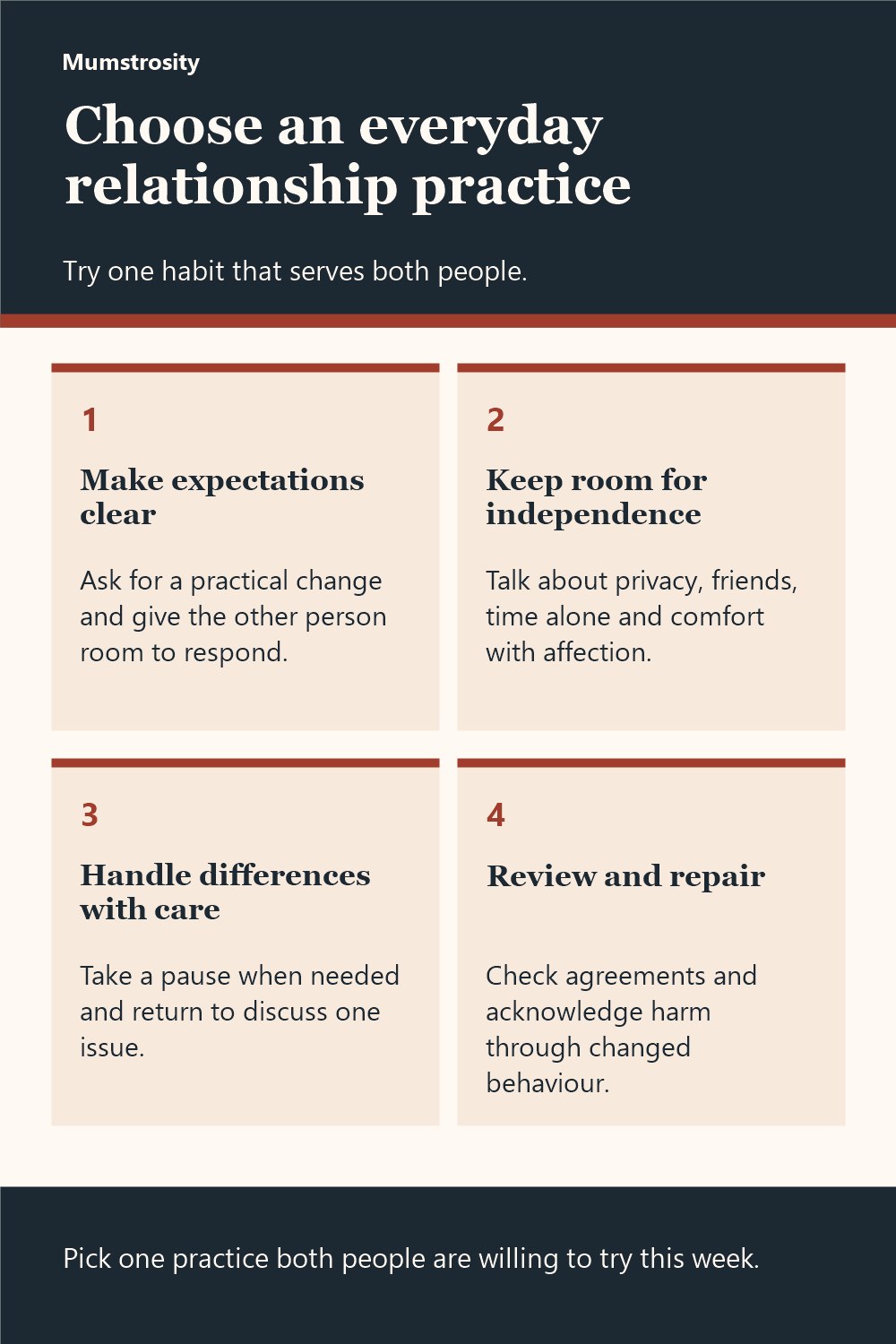
Choose an everyday relationship practice Try one habit that serves both people.
- Make expectations clear Ask for a practical change and give the other person room to respond.
- Keep room for independence Talk about privacy, friends, time alone and comfort with affection.
- Handle differences with care Take a pause when needed and return to discuss one issue.
- Review and repair Check agreements and acknowledge harm through changed behaviour.
Pick one practice both people are willing to try this week.