

When dating has been disappointing, “unlucky in love” may feel like the simplest explanation. You can acknowledge that disappointment without turning it into a judgement about your worth or deciding that you must try harder indefinitely.
Timing, opportunity and another person’s interest are not entirely within your control. These three choices can make dating more manageable and help you learn what suits you. They cannot guarantee a partner or a particular outcome.
On this page
1. Choose opportunities you would also enjoy
Think about where you would feel reasonably comfortable meeting people: an interest group, a community event, introductions through friends or a dating service you want to use. Pick an option that fits your time, energy, budget and access needs. You do not need an expensive or exhausting social schedule.
An activity can be worthwhile even if nobody there becomes a romantic interest. Enjoying the subject may give you something natural to talk about, but shared interests alone do not establish compatibility or availability.
Keep the setting in mind. Someone attending a class, volunteering or doing their job may not want romantic attention. A brief conversation leaves room for either person to disengage. Look for freely shared interest rather than treating every encounter as a chance you must seize.
If dating is taking more from you than it gives, reduce the effort or take a break. You are not losing a contest by resting, and meeting more people does not entitle anyone to a yes.
2. Notice what matters to you, alongside mutual interest
Consider a few preferences or limits that would affect everyday life. You might want a particular kind of commitment, compatible plans about children or respect for important beliefs. Other differences, such as hobbies or tastes, may matter less to you. Your priorities do not have to match someone else’s checklist.
Use questions and ordinary time together to learn, rather than trying to fit yourself into whatever another person wants. You can be open to someone different from you without ignoring a limit you want to keep.
Consider both directions of the connection. Do you enjoy their company, and do they show interest in yours? Can you disagree or decline an invitation without being pressured? A person being available does not mean that you have to continue dating them.
Our guide to early relationship choices looks at expectations, privacy and a pace that works for both people.
3. Make a clear invitation, then respect the answer
If an approach seems appropriate, keep it simple: “I’ve enjoyed talking. Would you like to have coffee sometime?” Offer room to decline without asking for an explanation or trying to persuade someone. A no, no response or lack of availability is a reason to step back.
If you both want to meet again, make a practical plan. You can discuss the pace of contact, affection and commitment directly as those questions become relevant. There is no universal schedule for a first kiss, introducing friends or saying that you want a relationship.
Love is respect’s physical-boundaries guidance emphasises that you decide what you feel ready for. Being interested in someone does not require accepting touch or intimacy you do not want.
Afterward, ask what you learned rather than whether you performed perfectly. You may want another date, a different approach or a pause. The next useful choice can be small, and your life can remain meaningful alongside whatever happens in dating.
Read the infographic in text
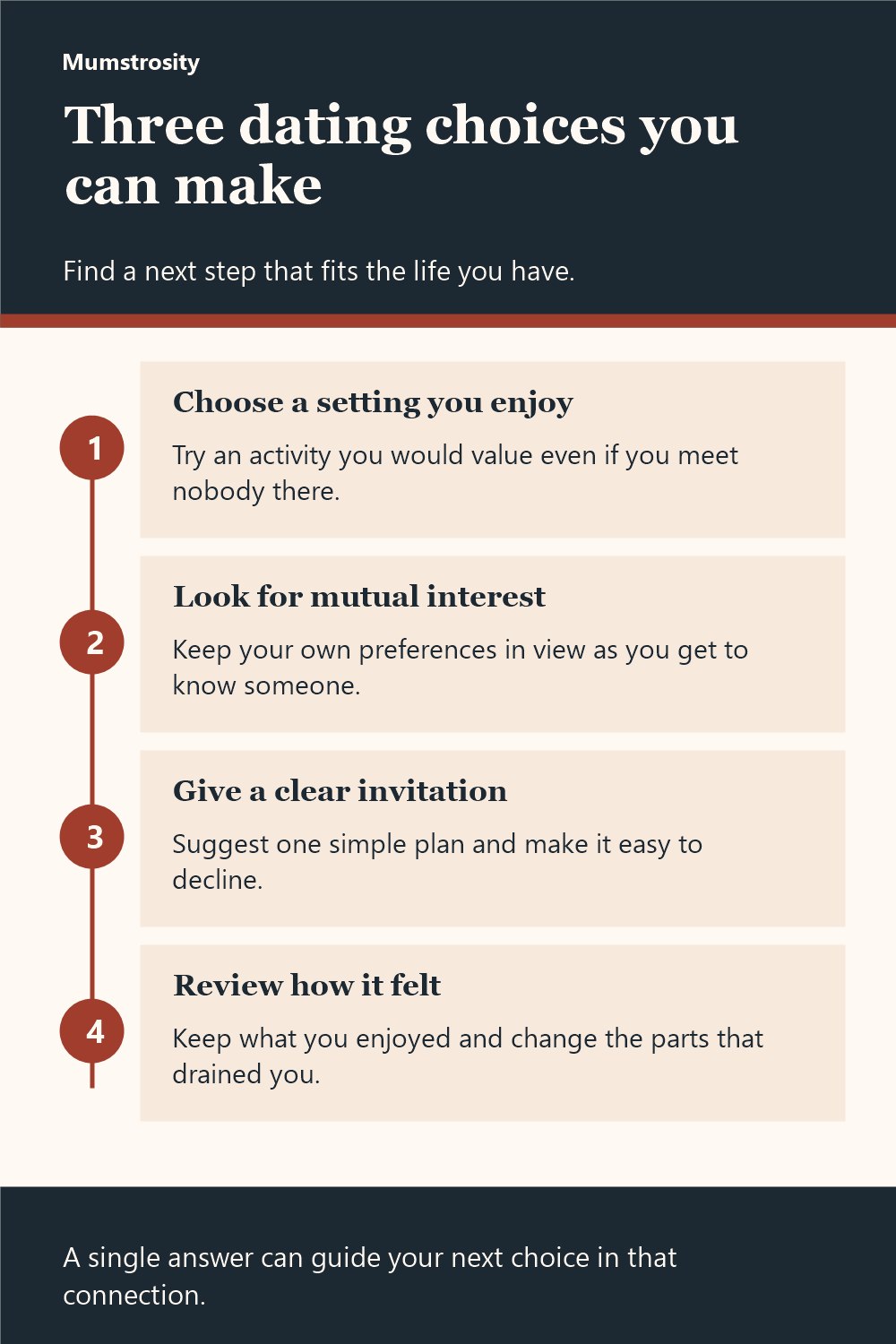
Three dating choices you can make Find a next step that fits the life you have.
- Choose a setting you enjoy Try an activity you would value even if you meet nobody there.
- Look for mutual interest Keep your own preferences in view as you get to know someone.
- Give a clear invitation Suggest one simple plan and make it easy to decline.
- Review how it felt Keep what you enjoyed and change the parts that drained you.
A single answer can guide your next choice in that connection.