

Early dating can bring excitement alongside uncertainty. You may want to be open while also protecting your time and privacy. There is no perfect sequence of messages, disclosures or dates that makes another person choose a relationship.
These seven pitfalls are prompts for reflection rather than reasons to criticise yourself. A more useful question is whether you can learn about each other while keeping your own choices intact.
On this page
- Assuming strong feelings mean shared plans
- Hiding interest to follow a dating rule
- Treating texting as a test of devotion
- Using intimacy to secure a relationship
- Confusing curiosity with entitlement to information
- Letting dating crowd out the rest of your life
- Explaining away behaviour that concerns you
1. Assuming strong feelings mean shared plans
You may feel attached quickly, slowly or unevenly. Feelings do not require you to make a commitment before you understand what you both want. Chemistry can coexist with different expectations about exclusivity, contact or the future.
Instead of guessing, ask a manageable question: “I’m enjoying seeing you. What are you looking for at the moment?” Take the answer seriously rather than treating it as a challenge to change their mind. You can also decide that their current plans do not suit yours.
2. Hiding interest to follow a dating rule
You do not have to pretend to care less than you do or disclose everything at once. Choose what you feel ready to share, and leave room for the other person to respond honestly. Matching every message length or delaying replies by a fixed number of hours cannot establish mutual interest.
A straightforward invitation can be enough: “I’d like to see you again. Would you like to meet next week?” If the answer is no, accept it. If it remains unclear, you can decide how much uncertainty you want to continue with.
3. Treating texting as a test of devotion
Some people enjoy frequent messages; others prefer less contact or cannot reply while working or caring for someone. Wanting contact does not make you weak, and being busy does not automatically mean someone is uninterested. Discuss what you each find comfortable.
You might agree that replies during work will be slower, or use a brief message to confirm the next date. Love is respect’s guide to digital boundaries offers questions about messages, online posts and account privacy. An agreement should leave both people free to put the phone down.
4. Using intimacy to secure a relationship
There is no universal date on which affection or sex becomes appropriate. What matters is that everyone involved can freely choose the activity, communicate limits and change their mind. Sex does not create a debt of commitment, and waiting does not guarantee one.
If you feel uncertain, pause. You can say, “I like you, and I want to take this more slowly.” A respectful response does not involve guilt, repeated pressure or a demand to prove your feelings.
5. Confusing curiosity with entitlement to information
Questions can help you learn about each other, but neither person has to provide an immediate account of every past relationship, financial detail or private experience. You can explain that a topic is personal or that you would rather discuss it later.
Privacy does not prevent you from asking about issues that affect your choices. For example, you may want clarity about whether someone is available for the kind of relationship you want. If an unanswered question matters to you, you can set a limit on your own participation rather than searching their phone.
6. Letting dating crowd out the rest of your life
Enjoying someone’s company need not mean cancelling friendships, losing sleep or dropping every activity you value. Keep time for ordinary routines and sources of support. This is not a strategy to appear more desirable; it is room to continue living your life.
If your schedules or expectations differ, look for an arrangement you both want. You should be able to spend time apart without punishment, surveillance or accusations that you must not care.
7. Explaining away behaviour that concerns you
A single awkward moment and a repeated pattern deserve different consideration. Pay attention to how someone responds when you say no, disagree or ask for a change. Attraction does not require you to dismiss contempt, dishonesty or pressure.
You do not need a diagnosis or an indisputable case to stop dating. If you feel frightened or controlled, get private support before a confrontation. If the issue is a mismatch, you can end things respectfully without deciding that either person is a failure.
Choose one topic you want to clarify next time you talk. Early dating is an opportunity to discover whether the relationship suits both people, with space for either person to decide otherwise.
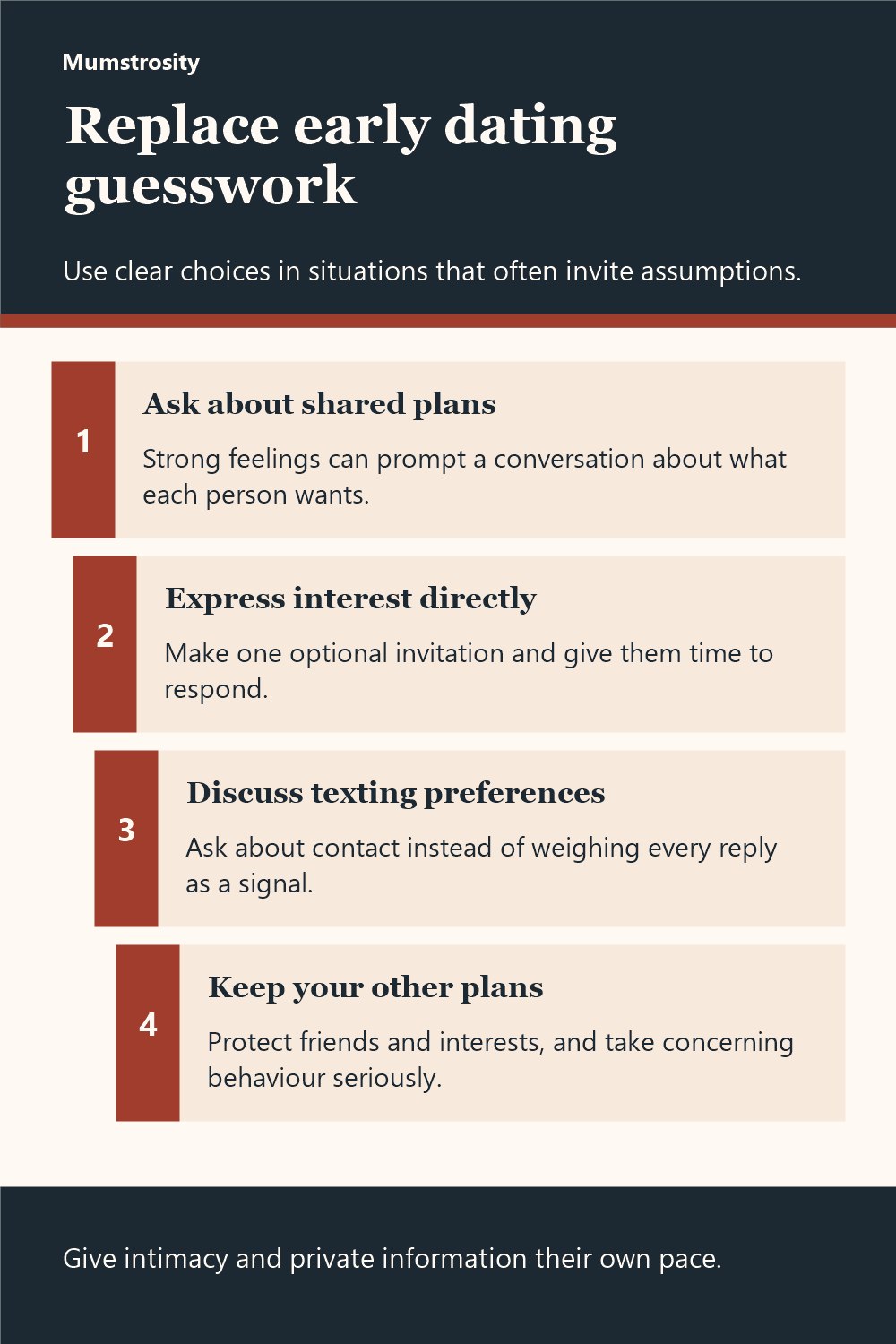
Read the infographic in text
Replace early dating guesswork Use clear choices in situations that often invite assumptions.
- Ask about shared plans Strong feelings can prompt a conversation about what each person wants.
- Express interest directly Make one optional invitation and give them time to respond.
- Discuss texting preferences Ask about contact instead of weighing every reply as a signal.
- Keep your other plans Protect friends and interests, and take concerning behaviour seriously.
Give intimacy and private information their own pace.