

Being in love can feel exciting, comforting, uncertain or all of these at different times. You do not have to experience constant intensity or put your own needs aside to prove that the feeling is real.
If you are asking whether someone is right for you, look at the relationship you actually share as well as how strongly you feel. These six questions can help you reflect. They cannot identify a destined partner or guarantee a future together.
On this page
1. Do you enjoy the connection in ordinary life?
Notice how it feels to spend everyday time together, not only how you feel before a special date. Can you enjoy a quiet conversation, make a small plan or share an activity that suits you both? Excitement may matter to you, but it need not be present at every moment.
Also notice what you are drawn to: the person as you know them, the idea of being chosen, or a future you hope will develop. You can be curious about that distinction without criticising yourself for wanting love.
2. Is there room for you as a separate person?
You can care deeply about a partner and still keep friends, interests, privacy and limits. Wanting time alone does not establish that you are less in love. Nor do you need to give up something important whenever your wishes differ.
Ask whether changes in your life feel freely chosen. A relationship should not require you to make yourself smaller to avoid disappointment, anger or rejection.
3. Are your limits and choices respected?
Consider what happens when you disagree, say no or ask for a change. Are you heard, even if the answer is difficult? Or do you face ridicule, pressure, punishment or attempts to control your choices?
Affection does not cancel out harmful behaviour. Love is respect’s boundary guidance emphasises being able to express needs and limits without fear of a partner’s response.
4. Does care go both ways in practice?
Care can involve listening, affection or practical support, and its form may change with circumstances. Notice whether both people’s needs receive consideration and whether agreements lead to action. Reliability is more useful to assess through ordinary follow-through than through promises to do anything for each other.
You do not need to be completely self-sufficient to deserve a relationship. At the same time, neither person should have to disappear into meeting every demand of the other.
5. Can you discuss the choices that matter to your future?
You may have different tastes and still enjoy a relationship. Other differences, such as whether you want children, where you hope to live or the kind of commitment you want, may affect whether a shared future would suit you.
Ask direct questions rather than assuming love will resolve those differences. Our guide to asking for what you need offers ways to turn a vague concern into a specific conversation. Take the answer seriously, including an answer you do not want.
6. Do you want to continue the relationship you have now?
Think about what is working, what concerns you and what would need to change. You can want to explore a difficulty without promising to stay indefinitely. You can also decide that a relationship is not right for you without proving that either person is incapable of love.
If you feel frightened or controlled, seek private support before arranging a confrontation. Otherwise, choose one topic to discuss and notice what the conversation reveals. Your decision can be based on your own experience and wishes, rather than a checklist of signs that someone must be the one.
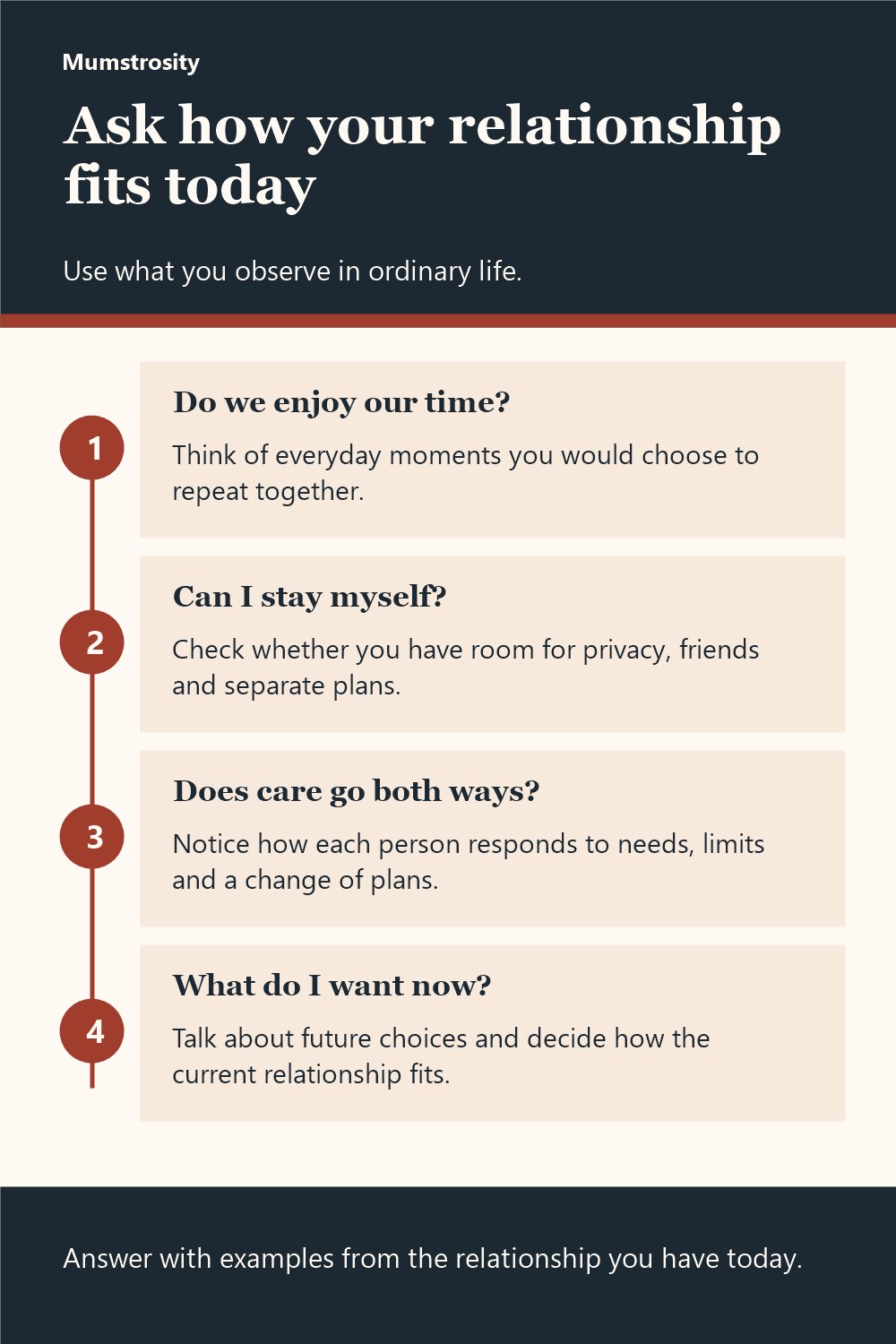
Read the infographic in text
Ask how your relationship fits today Use what you observe in ordinary life.
- Do we enjoy our time? Think of everyday moments you would choose to repeat together.
- Can I stay myself? Check whether you have room for privacy, friends and separate plans.
- Does care go both ways? Notice how each person responds to needs, limits and a change of plans.
- What do I want now? Talk about future choices and decide how the current relationship fits.
Answer with examples from the relationship you have today.