

Quite a number of couples usually ask me about this thing “chances” when they visit my office. How many chances should you get and give at the same time? How long should you suffer in a relationship? We should forgive our partners how many times? And many more.
There is no number of chances that every couple owes each other. If you are considering ending a relationship, the useful questions are what has happened, whether anything is changing and whether you want to continue. Love and a long history do not require you to accept repeated harm.
On this page
Start with your own choice
You may feel affection, anger, hope and exhaustion at the same time. Those feelings do not make the decision obvious, and you do not have to turn them into an immediate verdict. Ask yourself: if there were no pressure from my partner or anyone else, would I want to explore staying?
Choosing to try again should be voluntary. You can also decide that a relationship is no longer right for you, even if your partner wants to repair it. A breakup does not require agreement about who is at fault or proof that the other person is beyond change.
Decide what crosses a boundary
A forgotten task, a difference in plans and a deliberate deception are not interchangeable. Describe the specific action and its effect. Then consider whether it crosses a limit you want to keep. Someone else’s willingness to forgive the same behaviour does not set your standard.
Honesty, sexual consent, privacy and access to your own money may be especially important to you. You can treat a lie as a deal breaker; you are not required to dismiss it as a small mistake. Where the problem concerns different preferences, consider whether an arrangement would meet both people’s needs without either person being pressured.
Look for change beyond an apology
An apology may begin a conversation, but it cannot establish a new pattern by itself. Look for acknowledgement of the specific behaviour, responsibility without blaming you, and follow-through after the immediate disagreement has passed.
For example, if shared tasks keep falling to you, does your partner take responsibility without repeated reminders? If an agreed boundary was crossed, do they respect it when you are disappointed or say no? You should not have to police every action or keep explaining why the same harm matters.
A person can make an effort without being entitled to another chance. Our guide to rebuilding trust after hurt considers accountability alongside the other person’s freedom to choose.
Separate forgiveness from staying
You do not have to forgive on demand, stop feeling hurt by a deadline or remain a couple to show compassion. People use the word forgiveness differently. Whatever it means to you, it need not involve restoring trust, resuming contact or accepting the behaviour again.
Likewise, accepting that both partners are imperfect does not make both equally responsible for a particular action. You can acknowledge your own mistakes without taking responsibility for someone else’s coercion, threats or deception.
Make a specific plan if you both want to try
When discussion is safe and you both want another attempt, choose one concrete issue to work on. Agree what each person will do, what support might help and a time to review the arrangement. Keep the plan manageable rather than promising to change everything overnight.
For example: “We will agree a household task list on Sunday, each take ownership of our tasks, and discuss what worked in two weeks.” At the review, consider what actually happened and whether the arrangement helped. A review date is a chance to reassess, not a promise that you must stay until then.
Get support when leaving feels difficult
Shared housing, money, children or worries about loneliness may complicate a decision. A trusted person can help you think through practical needs without deciding for you. Love is respect’s breakup guidance recognises that support can matter while you are uncertain, staying or preparing to leave.
If you fear control, retaliation or violence, seek private help from a domestic abuse service before arranging a confrontation. The National Domestic Violence Hotline explains why couples counselling can be unsafe where abuse is present. In immediate danger, contact local emergency services if you can do so safely.
You can take your concerns seriously without finding the perfect label for the relationship. Another chance is one possible choice. It is never a debt you must repay.
Read the infographic in text
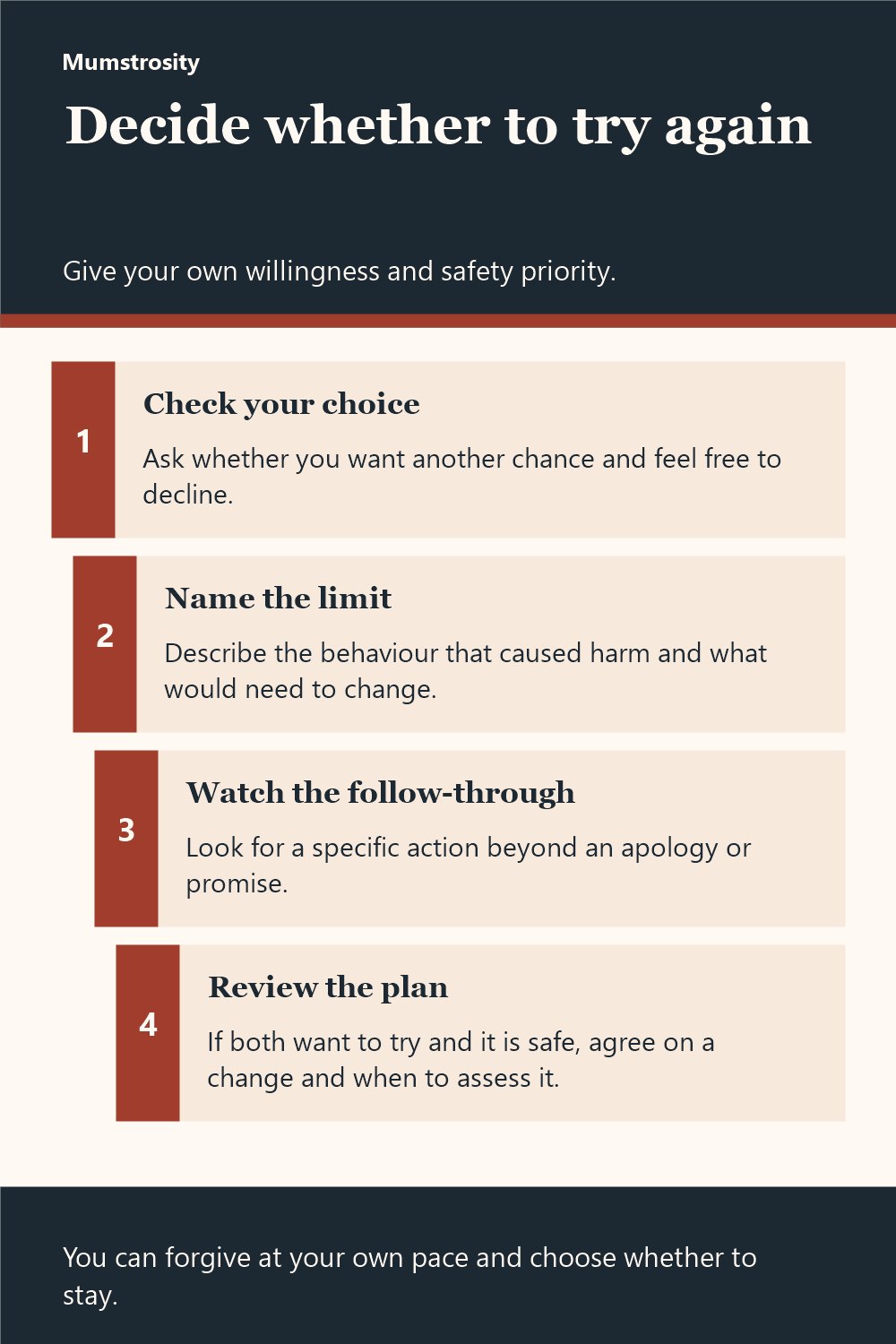
Decide whether to try again Give your own willingness and safety priority.
- Check your choice Ask whether you want another chance and feel free to decline.
- Name the limit Describe the behaviour that caused harm and what would need to change.
- Watch the follow-through Look for a specific action beyond an apology or promise.
- Review the plan If both want to try and it is safe, agree on a change and when to assess it.
You can forgive at your own pace and choose whether to stay.