

You can love someone and still question whether the relationship works for you. The decision may involve unmet needs, different plans, repeated harm or a wish for a different life. You do not need to prove that your partner is a bad person before deciding to leave.
Start with what is happening now, what choices you have and what support would help. A checklist cannot decide for you. It can help you separate a problem you both want to address from a situation in which you feel pressured, trapped or afraid.
On this page
1. Describe the need that is not being met
Be specific: you may want more time together, shared responsibility at home, honesty about money or a compatible plan for the future. If it is safe, explain what you need and ask whether your partner wants and can offer it. The answer may reveal a solvable arrangement or a difference neither of you can accept.
You can appreciate the good parts and still find the relationship unsuitable. No partner can meet every need, but that does not make an important unmet need unreasonable. You also do not have to keep asking indefinitely for basic respect.
2. Keep support beyond the relationship
Turning to friends, relatives, colleagues or a counsellor is not, by itself, evidence that you should break up. A partner does not have to be your first contact for every piece of news. Support outside the relationship can remain valuable whether you stay or leave.
Ask a more useful question: is there a kind of closeness you want with your partner that is consistently missing? You might want more listening or more shared time. Discuss that need without treating other trusted relationships as a threat or cutting them off to prove loyalty.
3. Notice whether you can speak without fear
Feeling awkward about a difficult conversation differs from fearing threats, retaliation or humiliation. Love is respect describes expressing needs and limits without fear as part of setting relationship boundaries. You should not have to earn the right to decline.
If speaking up could put you at risk, seek private support before confronting your partner or announcing plans. You do not have to find better words to prevent another person’s abusive behaviour. Their choices remain their responsibility.
4. Listen to specific concerns from people you trust
Someone close to you may notice conduct you have become used to, such as repeated insults, isolation or pressure over money. Ask what they have observed and consider the examples. Concrete concerns are more useful than a blanket verdict about whom you should date.
Friends and family can also misunderstand a relationship or hold unfair prejudices. Their approval is not a requirement. Choose people who respect your autonomy, can listen without shaming you and will help you consider your circumstances rather than make the decision for you.
5. Separate the relationship’s history from your present choice
Years together, shared memories and plans can make leaving feel like losing part of your future. Those feelings matter, but past effort cannot tell you whether continuing will meet your needs now. Consider what you would be choosing if the current pattern continued.
Housing, income, children, disability or immigration circumstances may limit what you can do immediately. These are practical barriers, not evidence that you lack self-respect. A trusted person, local support service or appropriately qualified adviser may help you understand options without forcing an immediate decision.
6. Look for practical change rather than a universal deadline
If you both want to address a problem and can do so safely, name the change each person will make and when you will review it. For example, agree who will take responsibility for a recurring task and check whether the new arrangement actually happens.
There is no one-year rule that decides when every relationship should end. You can choose a review point that suits the issue, and you can decide sooner that you do not want to continue. Promises and apologies deserve consideration alongside repeated behaviour, without requiring you to wait through more harm.
7. Plan for leaving in a way that fits your safety
If you decide to leave a respectful relationship, a clear statement can be enough: “I have decided to end our relationship.” You may need separate arrangements for belongings, housing or shared responsibilities. You do not need the other person to agree that your reason is sufficient.
Where abuse, stalking, threats or control are involved, get help with an individual safety plan. The breakup guidance from love is respect explains that an in-person conversation is not required when it would be unsafe, and risks may continue afterward. Consider using a safer device if your activity may be monitored. In immediate danger, contact local emergency services if it is safe to do so.
You can ask for support while uncertain, while staying or after leaving. For the days afterward, our guide to manageable care after heartbreak offers ideas for ordinary routines and contact choices.
Read the infographic in text
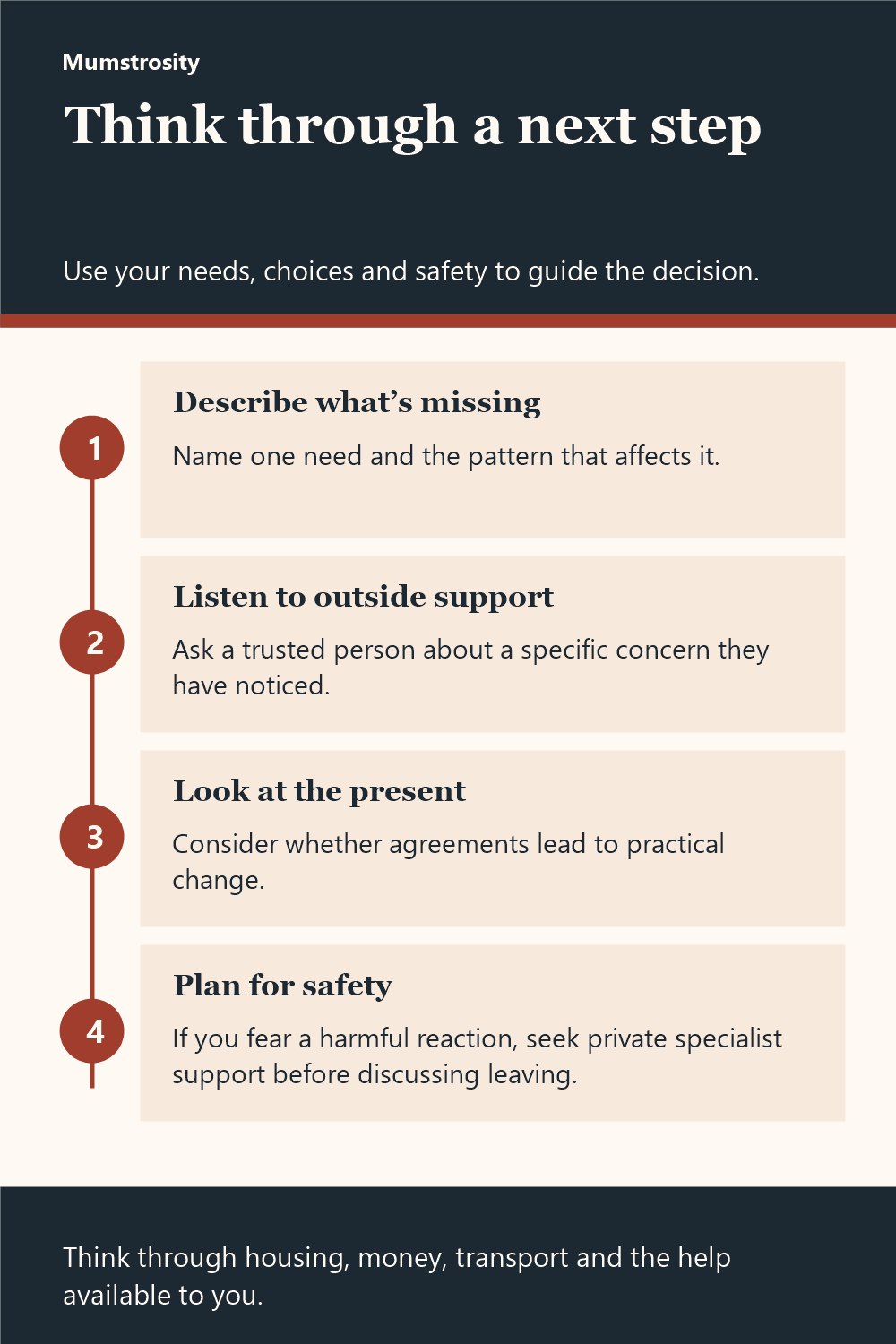
Think through a next step Use your needs, choices and safety to guide the decision.
- Describe what’s missing Name one need and the pattern that affects it.
- Listen to outside support Ask a trusted person about a specific concern they have noticed.
- Look at the present Consider whether agreements lead to practical change.
- Plan for safety If you fear a harmful reaction, seek private specialist support before discussing leaving.
Think through housing, money, transport and the help available to you.