

Asking for what you need can feel awkward, especially if you hope your partner will notice without being told. A clear conversation can help you understand each other, but it cannot make someone agree or guarantee that the relationship will meet every need.
Use these ten prompts to make one concern more specific. Choose a conversation that feels safe, keep your own limits in view and leave room for an answer you may not have expected.
On this page
- Name the need before choosing a solution
- Ask for a specific action
- Invite the other person’s needs into the conversation
- Clarify the relationship you want
- Discuss how your lives overlap
- Choose what you are ready to disclose
- Separate an old fear from a current concern
- Make room for different social preferences
- Agree on one manageable change
- Consider the response as well as the words
1. Name the need before choosing a solution
Start with the experience you want to change: feeling rushed, missing time together or carrying more than your share of a task. Then consider what might help. You do not need a quiz or a fixed personality category to explain a preference.
For example, “I miss having time to talk” is a starting point. A weekly walk might be one possible solution, rather than the only acceptable proof of care.
2. Ask for a specific action
Describe what you noticed, how it affects you and what you are asking for. “When plans change at the last minute, I lose the evening I set aside. Could you let me know earlier when possible?” is clearer than asking someone to be more thoughtful in general.
A request can be direct without becoming an insult or a verdict on character.
3. Invite the other person’s needs into the conversation
Ask whether the proposed change is workable and what the other person wants you to understand. You can care about their answer without withdrawing your own need immediately.
Giving affection, favours or a massage does not create a debt that requires a particular response. Discuss what you each want instead of making care a transaction.
4. Clarify the relationship you want
If commitment or exclusivity matters to you, ask about it directly when you feel ready. You might say, “I’m interested in an exclusive relationship. Is that something you want?” There is no wording that can ensure someone shares your plans.
A different answer can be disappointing and still useful. You can decide what you want to do with that information.
5. Discuss how your lives overlap
Ask before assuming that a partner wants to attend every event, meet every friend or share every interest. Offer a particular invitation and let them respond. Different levels of social involvement may need discussion rather than a test of devotion.
You can also say what matters to you, such as introducing a partner to important people in your life.
6. Choose what you are ready to disclose
Sharing a feeling or explaining a limit may help someone understand you. It does not require revealing every painful experience, handing over passwords or disclosing something before you are ready.
You can say, “This topic is difficult for me; I would like to go slowly.” Respect for a boundary matters even when you do not provide its entire history.
7. Separate an old fear from a current concern
A previous experience may affect what feels difficult now. If useful, describe the concern without making your current partner responsible for another person’s actions. Then look at what is happening in this relationship.
Past hurt also does not make a present problem imaginary. You can discuss an actual broken agreement or repeated behaviour without being required to dismiss it as baggage.
8. Make room for different social preferences
Talk about the kind of time you each enjoy, including nights out, quiet evenings and separate plans. Wanting a committed relationship does not require abandoning social life or following one model of settling down.
Consider whether your preferences can coexist in an arrangement you both freely choose. A substantial mismatch may matter even when neither person is doing something wrong.
9. Agree on one manageable change
Choose a practical action and a time to review it. If you miss time together, you might try an uninterrupted dinner once a week and discuss whether it helped after a few weeks.
A review is a chance to learn, not a deadline by which someone must feel satisfied. You may need to adjust the plan or acknowledge that it is not meeting the need.
10. Consider the response as well as the words
Notice whether you can speak without ridicule or threats, whether both people can decline a request and whether agreements lead to action. Communication requires participation from both people; choosing perfect words cannot compensate for someone’s refusal to respect you.
Love is respect’s conflict-resolution guidance distinguishes respectful disagreement from fear of retaliation. If you feel unsafe, seek private support before a confrontation. You can set a limit on what you will participate in or leave a relationship that does not work for you.
Read the infographic in text
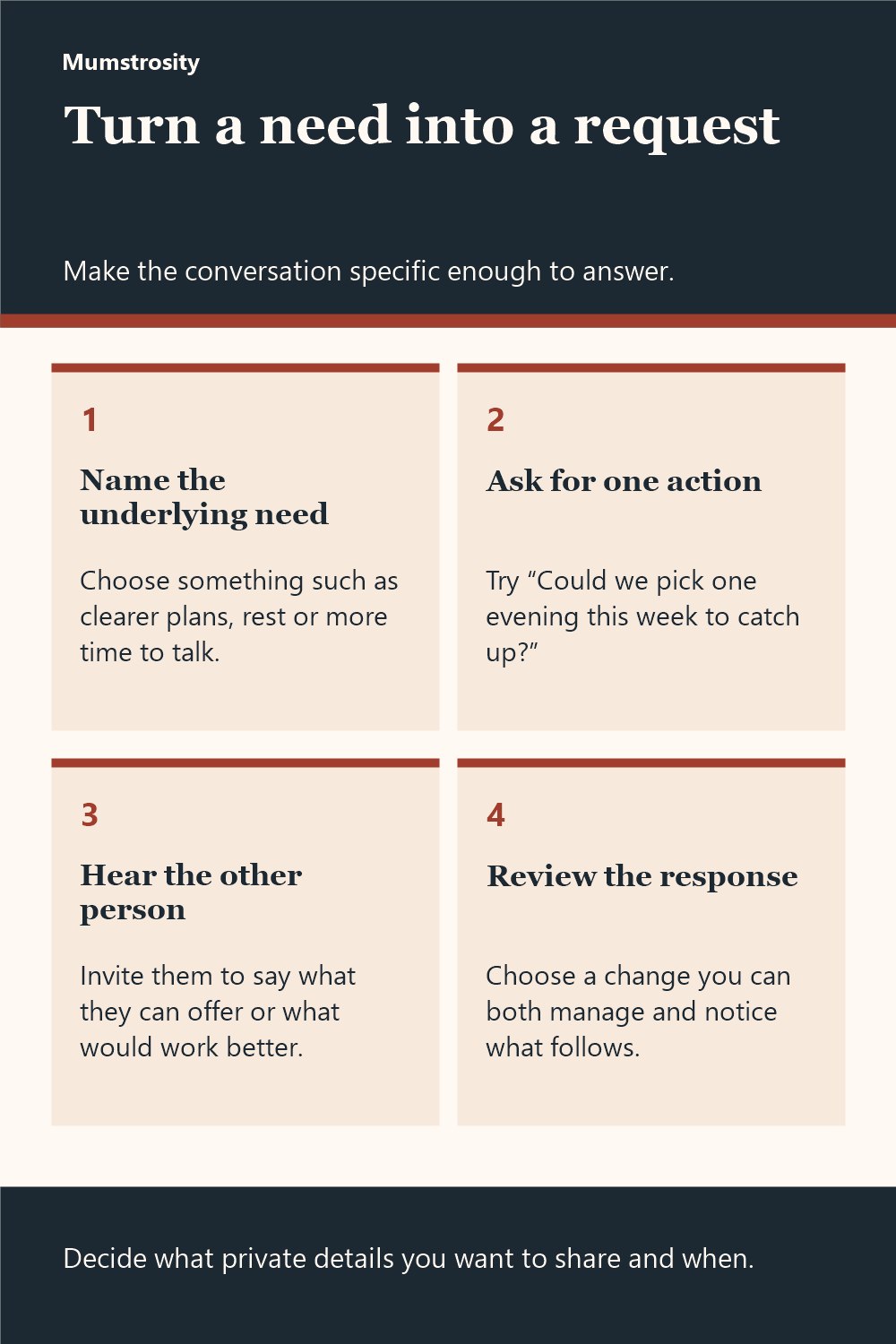
Turn a need into a request Make the conversation specific enough to answer.
- Name the underlying need Choose something such as clearer plans, rest or more time to talk.
- Ask for one action Try “Could we pick one evening this week to catch up?”
- Hear the other person Invite them to say what they can offer or what would work better.
- Review the response Choose a change you can both manage and notice what follows.
Decide what private details you want to share and when.