

Jealousy can feel uncomfortable and urgent. You may worry about losing someone, compare yourself with another person or feel unsettled after an agreement was broken. The feeling deserves attention, but it cannot prove what your partner is thinking or justify controlling their choices.
Start by separating the feeling, the facts you have and the action you are considering. You can take a concern seriously while choosing a response that respects both people’s privacy, friendships and freedom.
On this page
1. Pause before acting on the feeling
If you want to send an accusation, check a phone or demand an explanation immediately, pause long enough to choose what you will do next. Put the message aside, take a brief break or write down the concern privately if that is safe.
The aim is to make space for a decision, rather than force the emotion to disappear. You can return to the issue when you are ready. If you have already shouted, insulted or invaded someone’s privacy, take responsibility for that specific behaviour without blaming the feeling or your partner for your actions.
2. Separate what happened from what you fear it means
Write a short factual description: “They cancelled our plan,” or “I saw a message I did not understand.” Then identify the interpretation: “They no longer want me,” or “They must be cheating.” The interpretation may need a question, rather than being treated as an established fact.
A previous betrayal or a current broken agreement matters. You do not have to explain away evidence to appear trusting. Equally, a partner having friends, wearing clothes they enjoy or taking time to reply does not by itself establish dishonesty. Consider the context and the agreements you actually made.
3. Name the need you want to discuss
You might want clarity about exclusivity, more reliable plans or reassurance after a difficult event. Make a request the other person can understand: “When our plans change, please tell me as soon as you can,” or “Can we talk about what exclusivity means to each of us?”
Choose a suitable time if conversation is safe. Listen to the response and decide whether the available arrangement suits you. Reassurance can be welcome, but your partner cannot be required to remove every uncertain feeling or give up other relationships to keep you comfortable.
4. Discuss agreements that respect both people
Talk about contact, privacy and relationship expectations without assuming you already agree. An arrangement should leave room for either person to decline or raise a concern. If your preferences differ, that may require a compromise or a decision about compatibility.
Love is respect’s guide to disrespect, jealousy and controlling expectations explains why feelings do not justify restricting a partner’s friends, clothing or online activity. Demanding passwords, secretly checking messages or tracking someone is not a fair substitute for trust.
5. Notice when a partner’s jealousy becomes pressure
You can acknowledge that a partner feels insecure without accepting repeated accusations, threats, humiliation or demands to isolate yourself. Changing your routine to avoid an outburst is a reason to consider your safety and seek individual support.
If you fear the response to a boundary, speak privately with a trusted person or a local relationship-abuse service before confronting the partner. Use a safer device if your activity may be monitored. You do not have to resolve a controlling situation through another joint conversation.
6. Choose support and a workable next step
If jealousy keeps taking over your attention or leading to harmful behaviour, individual professional support may help you work on your responses. Keep interests and supportive connections outside the relationship too. These are options for care, not a promise that a feeling will disappear on a schedule.
Your next step might be a clear question, an apology with a change in behaviour, a revised agreement or a decision to step back. You can work on your own responses while also deciding that a relationship’s current level of honesty or respect is not enough for you.
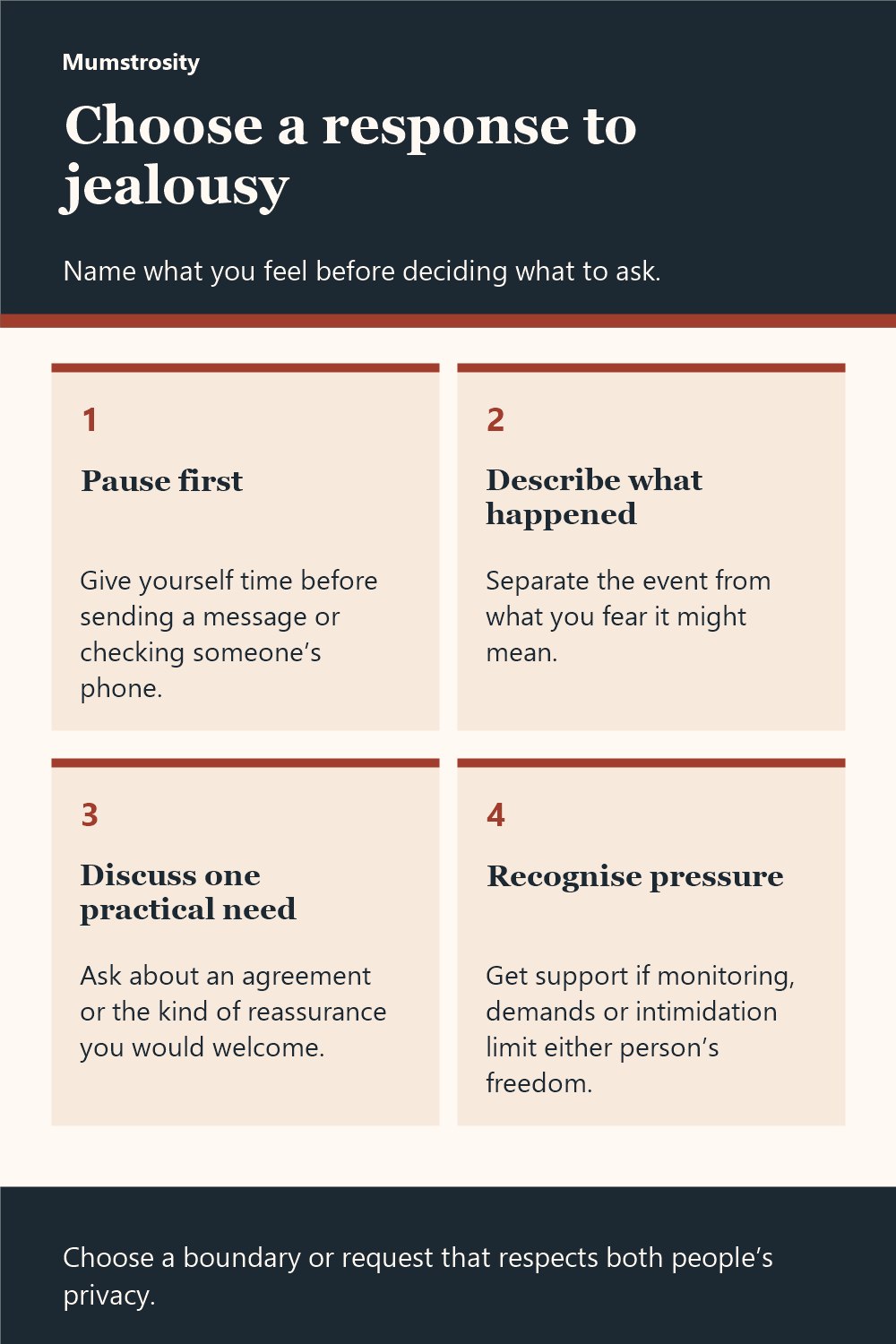
Read the infographic in text
Choose a response to jealousy Name what you feel before deciding what to ask.
- Pause first Give yourself time before sending a message or checking someone’s phone.
- Describe what happened Separate the event from what you fear it might mean.
- Discuss one practical need Ask about an agreement or the kind of reassurance you would welcome.
- Recognise pressure Get support if monitoring, demands or intimidation limit either person’s freedom.
Choose a boundary or request that respects both people’s privacy.