

A relationship can feel wrong for different reasons. You might feel rushed, miss a kind of closeness, want something your partner does not want or feel unable to disagree safely. Start by describing the concern instead of deciding that one feeling proves what the whole relationship means.
These questions can help you notice what needs a conversation, what reflects a difference in preferences and what calls for support. You do not need a dramatic incident to take your own discomfort seriously.
On this page
1. Is the pace comfortable for both of us?
Excitement and strong feelings do not automatically mean that something is wrong. Ask whether you can slow down, keep plans of your own and make decisions without being pressured. A pace that one person enjoys may feel overwhelming to the other.
For example, you may want fewer overnight visits or more time before discussing a shared home. Say which change would help. Notice whether your partner can hear the request without treating it as a betrayal or demanding an immediate promise.
2. What does an ordinary week in this relationship feel like?
Familiarity can feel peaceful, repetitive or a mixture of both. A quiet routine is not proof that love has gone, and wanting more variety does not make either person shallow. Describe what you miss: conversation, shared activities, affection or time outside the home.
Suggest an experiment you both want, such as a planned evening together or taking turns choosing an activity. You can learn from the response without expecting a single date to resolve a larger difference in what you want.
3. Can I make a free choice?
Consider what happens when you say no, change your mind or spend time apart. You should be able to have preferences without threats, intimidation or repeated punishment. Affection does not require surrendering privacy, friendships or control over your own time.
If you notice that you are pressuring your partner, take responsibility for the specific behaviour. Make a request they can decline, accept the answer and seek help to change harmful patterns. Your distress does not make them responsible for agreeing.
4. How is care expressed, and what am I asking for?
One person may value practical help while another especially wants uninterrupted time. Missing a particular gesture does not, by itself, prove a lack of love. Explain the kind of care you would appreciate and ask what is realistic.
Consider the wider pattern too. Are your needs usually taken seriously? Do both people get to ask for support and have limits? You can recognize a partner’s effort while deciding that the relationship still does not meet needs that matter to you.
5. What happens when I raise a concern?
Choose a specific issue and a suitable moment if it feels safe to talk. Explain what happened, how it affected you and what change you are asking for. Allow room for a different view without abandoning the issue you raised.
The relationship spectrum from love is respect offers a way to consider healthy, unhealthy and abusive behaviours. Notice repeated responses over time rather than turning one imperfect conversation into a verdict or accepting repeated harm as normal.
6. What next step would help me choose more clearly?
You could make a clear request, take time to reflect, speak to someone you trust or decide that the relationship no longer fits. You do not need to prove that your partner is a bad person to choose a different life.
If you are afraid of the reaction to a boundary or to leaving, seek individual support from a trusted person or a local domestic-abuse service. Prioritize a plan that fits your circumstances and safety. You do not have to confront the person before asking for help.
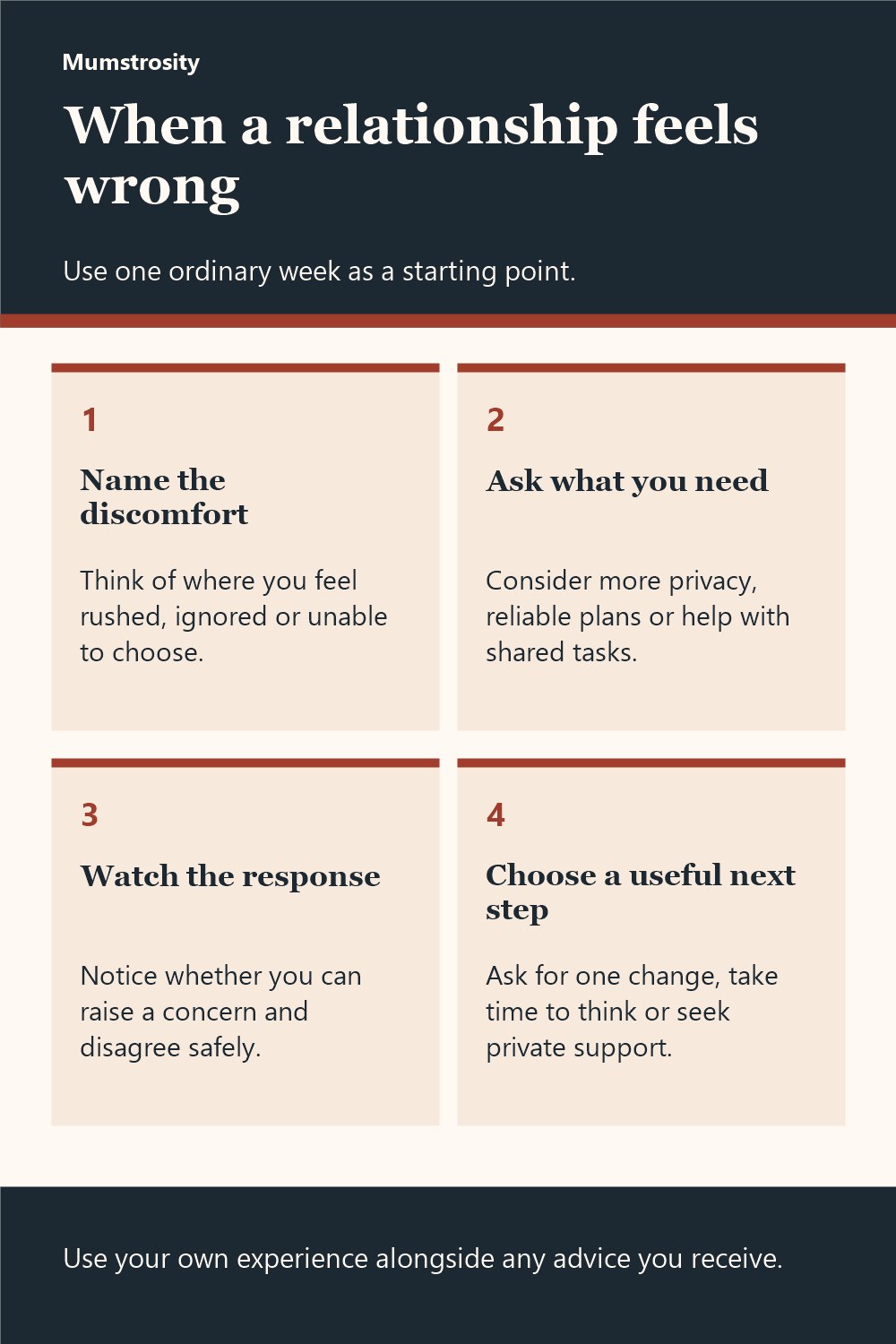
Read the infographic in text
When a relationship feels wrong Use one ordinary week as a starting point.
- Name the discomfort Think of where you feel rushed, ignored or unable to choose.
- Ask what you need Consider more privacy, reliable plans or help with shared tasks.
- Watch the response Notice whether you can raise a concern and disagree safely.
- Choose a useful next step Ask for one change, take time to think or seek private support.
Use your own experience alongside any advice you receive.