

Emotional manipulation can leave you feeling pressured, confused or afraid to disagree. Focus on what is happening and how it affects your choices, rather than trying to prove what another person is thinking. You can take a troubling pattern seriously without assigning a diagnosis.
One disagreement or an awkward conversation does not tell the whole story. Threats, intimidation and repeated attempts to control your choices deserve attention. If raising a concern could put you at risk, prioritize support and safety over a confrontation.
On this page
1. Look at behaviour in context
Consider a specific incident: what was requested, what you said and what happened when you disagreed. Notice whether you could decline freely or whether refusal brought threats, punishment or repeated pressure.
Sharing a difficult experience or becoming close quickly is not, by itself, evidence of manipulation. The concern is whether that closeness is later used to demand access, secrecy or compliance that you do not want to give.
Letting you speak first can be ordinary listening. Asking a question is not automatically an attempt to control you either. Look at whether the person listens to your answer or repeatedly twists it into a reason you must do what they want.
2. Separate the facts from pressure about your interpretation
People can remember an event differently. A useful conversation leaves room to clarify what happened. Repeatedly denying clear events or telling you that your concerns are imaginary can make it harder to trust your own judgment.
If it is safe, a private record of incidents may help you describe a pattern to someone you trust. Consider whether anyone else could access it; keeping notes is optional, and you do not need a perfect record to seek support.
Being called irrational, overly sensitive or incapable of understanding does not resolve the issue you raised. You can return to the specific behaviour: what was said, what happened and what you need to decide next.
A calm expression does not prove that someone is manipulative, just as crying does not prove that they are truthful or untruthful. Judge the behaviour and the freedom you have to respond, rather than treating a style of emotion as evidence.
3. Notice humiliation, intimidation and control
The National Domestic Violence Hotline’s guide to emotional abuse describes behaviours including threats, humiliation, monitoring and isolation. Physical violence is not required for a relationship to be harmful.
In a workplace or shared responsibility, complicated procedures may have a genuine purpose. If you are concerned about unfair treatment, ask for clear requirements or appropriate support rather than assuming paperwork alone proves an intention to manipulate.
A joke that repeatedly humiliates you deserves attention, particularly when you have said that it hurts. Calling it a joke does not remove its effect. Notice whether the person listens and changes the behaviour.
Specific feedback is different from repeated insults about your intelligence, appearance or worth. You do not need to discover the person’s insecurity or motive before deciding that the treatment is unacceptable to you.
Private information and vulnerabilities should not become tools for threatening or embarrassing you. You can reconsider what you share and seek advice about protecting information already disclosed.
4. Recognize guilt and blame without dismissing ordinary needs
A person can be disappointed by your answer without pressuring you to change it. The concern is whether disappointment becomes punishment, threats or a repeated claim that caring about them requires ignoring your own limits.
Both people may have problems to discuss. If your concerns are repeatedly dismissed whenever you raise them, notice that pattern and whether there is any space for your experience.
Comparing hardships can shut down a conversation. You can ask for a turn to speak without needing to prove that your day was worse than someone else’s.
Help and gifts do not create an unlimited debt. Agreeing to one favour does not mean accepting future demands, unwanted intimacy or access to your private life.
Accountability includes naming a harmful action and changing it. An apology that repeatedly becomes an explanation of why you caused the behaviour does not settle the concern.
Having difficult feelings is not a failure to love someone. You can care about their feelings while still deciding what you will share, agree to or continue.
If guilt is making a decision feel urgent, consider whether you can pause and speak to someone outside the situation. A request does not become an obligation simply because it is repeated.
5. Consider boundaries, communication and personal space
A boundary can describe what you will do, such as ending a conversation when insults begin. It cannot guarantee another person’s response. You do not have to deliver a perfect boundary statement before you deserve respectful treatment.
Taking time to calm down can be helpful when there is an agreed way to return to a conversation. Repeated withdrawal used to punish or force agreement is different. Consider the pattern and its effect rather than labelling every quiet period as abuse.
If you are afraid of how the person might react, it may be safer to discuss options with a trusted supporter or specialist advocate before announcing a plan. You are not responsible for making another person stop being controlling.
6. Choose support and a safer next step
A trusted person or a local domestic-abuse service can help you think through options. The Hotline offers a personal safety-planning resource for people experiencing abuse, considering leaving or adjusting after leaving. Use a safer device if you think your internet activity is monitored.
In the United States, you can contact the National Domestic Violence Hotline at 800-799-7233 or text START to 88788. Elsewhere, look for a local domestic-abuse service. If you are in immediate danger, contact your local emergency service when it is safe to do so.
You do not have to confront someone, obtain an apology or make every decision today to ask for help. Choose the next step with your circumstances and safety in mind. Responsibility for harmful behaviour belongs to the person doing it.
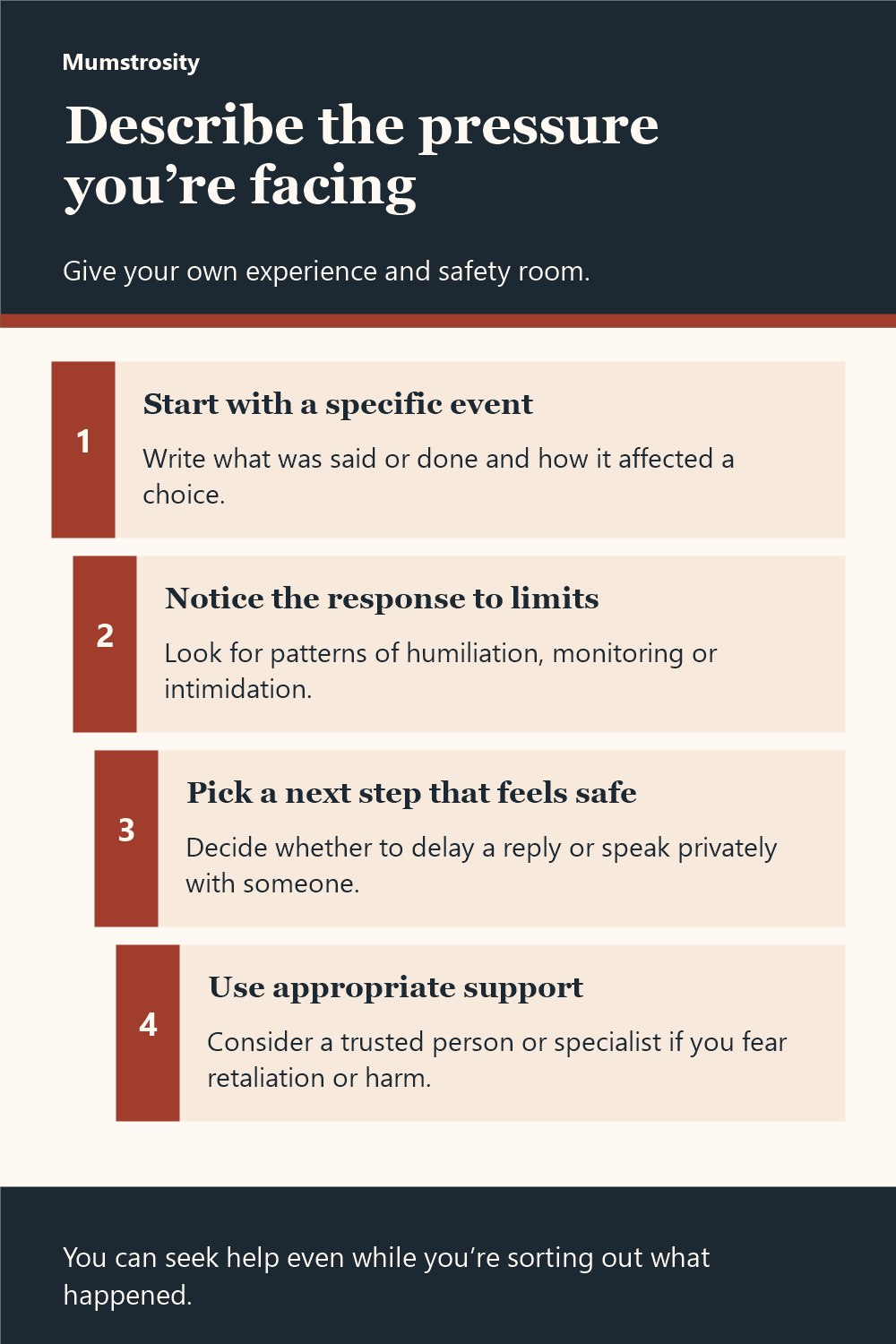
Read the infographic in text
Describe the pressure you’re facing Give your own experience and safety room.
- Start with a specific event Write what was said or done and how it affected a choice.
- Notice the response to limits Look for patterns of humiliation, monitoring or intimidation.
- Pick a next step that feels safe Decide whether to delay a reply or speak privately with someone.
- Use appropriate support Consider a trusted person or specialist if you fear retaliation or harm.
You can seek help even while you’re sorting out what happened.